Voice over Internet Protocol (VoIP) has come a long way since replacing the limitations of Plain Old Telephone Service (POTS). It began as a cost-effective alternative and has since become the backbone of modern business phone service that powers cloud communications and advanced virtual phone systems.
The VoIP industry shows an upward trend in scaling and acquiring the marketplace. According to market reports, the global VoIP market trend is projected to surpass $100 billion by 2025, driven by businesses that need faster and more flexible connections. Organizations are increasingly choosing VoIP for its scalability, lower VoIP costs, and advanced VoIP features.
In this blog, we will discuss the top 10 VoIP industry trends to watch in 2025, along with the necessary insights you should know. By the end of this blog, you will have a clear idea of VoIP marketing and its emerging trends.
Top 10 VoIP trends to watch in 2025
The VoIP industry is growing at a noticeable rate, and businesses are switching from POTS lines to adopt cloud solutions to be more advanced, secure, and user-friendly than ever before.
In fact, the global VoIP service market is estimated to be valued at $178.89 billion in 2025 and is projected to reach $413.36 billion by 2032 at a compound annual growth rate (CAGR) of approximately 12.7%. These statistics clearly explain the significant rise in the VoIP marketplace, and it is actually changing the way we interact over time.
Let’s discuss the top VoIP trends we should watch in 2025 to stay updated and ahead of the competition in terms of interactions.
1. AI-powered customer service
Artificial intelligence (AI) is no longer a fancy term; it has become an important part of the call center. If you are willing to provide exceptional customer support, you need to keep up with the most emerging tech trends, such as AI and machine learning, for predictive and sentiment analysis.
AI can now provide real-time customer service scripts, suggested responses, and even automate simple queries through Interactive Voice Response (IVR) systems. This leads to faster resolutions and reduces Average Handle Time (AHT), improving both productivity and customer experience.
The largest VoIP companies rely on AI technologies such as:
- Machine learning: To continuously improve predictions and responses based on call patterns.
- Natural language processing (NLP): To understand customer queries in real time for accurate response suggestions.
- Natural language understanding (NLU): To detect customer intent and sentiment to personalize interactions.
- Predictive analytics: To anticipate customer needs and route calls to the right agent proactively.
For example, AI-powered bots are already handling millions of customer queries each year, and Gartner predicts that agentic AI will solve 80% of customer problems by 2029. For businesses, this means fewer manual processes and more personalized service without putting extra pressure on the team.
2. Cloud-based VoIP adoption
The transition to the cloud-based VoIP system is escalating faster than expected due to greater flexibility, scalability, and cost-effectiveness. Reports show that the demand for cloud-based contact centers is surging, with the market anticipated to grow by 26% between 2024 and 2029.
Even highly regulated industries like finance and healthcare are making the switch because of built-in compliance features. This is because cloud-based VoIP provides the freedom to make calls from anywhere with advanced features like call routing, forwarding, recording, analytics, virtual numbers, and voicemail-to-email.
Additionally, it provides you the scalability option to grow as your business expands. This way, you do not have to worry about adding/removing extensions and high maintenance costs.
Example: A startup with a team spread across three countries can set up a global VoIP system in hours. Employees log into the same cloud dashboard, and the company gets international numbers without opening physical offices.
3. Smart VoIP assistants
A smart VoIP assistant refers to an intelligent virtual agent that is integrated into VoIP systems using AI and NLP to automate tasks like scheduling, routing, and transcribing voicemails. These assistants handle routine tasks and free up human agents to focus on other complex tasks.
Unlike traditional IVR systems, the AI-driven assistants use natural language processing to understand queries and respond instantly. They integrate well with a business phone app to provide real-time support without human intervention.
Benefits of smart VoIP assistants:
- 24/7 availability: handles calls even when your team is offline.
- Faster resolutions: Route callers directly to the right department, reducing average handle time (AHT).
- Consistency: Maintains that every customer interaction aligns with your service standards and customer service scripts.
- Easy access: Available through both VoIP mobile and desktop apps for instant management.
For growing businesses, intelligent assistants can deliver quick and accurate responses while freeing up staff for more complex tasks.
4. Omnichannel customer experience
Customers now are not happy with just a good service; they expect personalization at every step, and to keep up with that demand, businesses rely on technology like omnichannel. It is a solution that helps you integrate interactions across multiple channels like voice calls, live chat, email, and even social platforms into one unified system.
The main goal of omnichannel is to provide a better customer experience by integrating all the possible channels your business uses into a single unified dashboard so your agents can respond to a call and reply to text simultaneously without losing context. This way, even customers feel valued, as they don’t have to repeat themselves while switching channels.
Why omnichannel matters for your business?
- It combines business phone service, live chat, social media, and video conferencing under one system.
- It helps you track conversations across channels and analyze them to improve customer service scripts.
- Customers get faster resolutions with their preferred channel to reach you.
- Businesses that invest in omnichannel strategies are likely to receive higher customer retention.
In short, omnichannel contact center solutions turn every interaction into an opportunity to deliver consistency that an old POTS line could never achieve.
Example:
A customer browses a bookstore’s website and chats online to get personalized book suggestions. They place an order through the mobile app for in-store pickup. When they arrive, staff, aware of their preferences, recommend a sequel and quickly process the pickup. This connected journey highlights a seamless omnichannel experience.
5. Integration with IoT devices
VoIP integrates with Internet of Things (IoT) devices to create an intelligent interaction system where physical devices exchange data and can be controlled through voice or automated actions. The future of VoIP is about integrating with the entire digital ecosystem.
As the IoT adoption grows, businesses are starting to integrate smart devices with VoIP systems to create more connected and responsive environments. Almost 30 billion IoT devices are expected to be connected by 2030, up from nearly ten billion in 2020, a CAGR of nearly 12% over the decade.
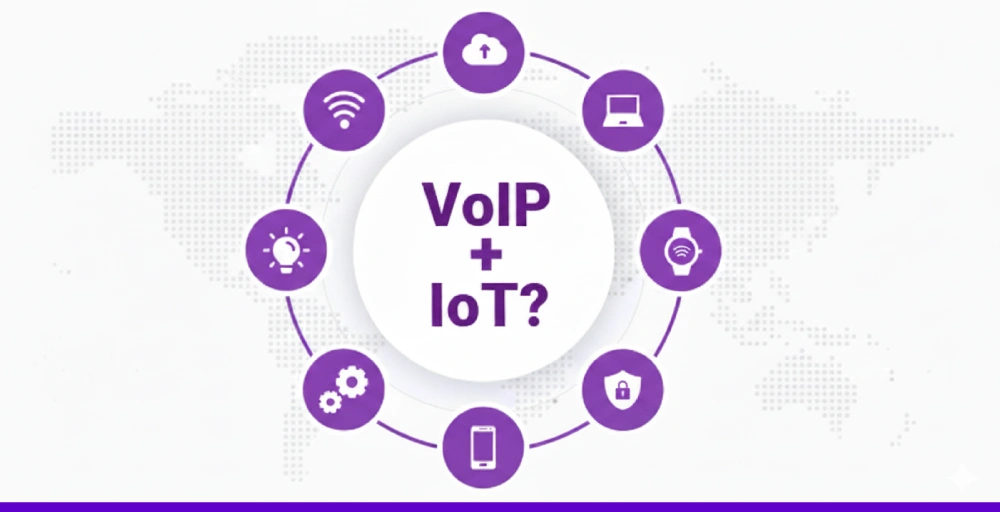
Imagine a virtual phone system connected to your office’s IoT-enabled devices. A VoIP phone can trigger alerts when motion sensors detect activity after hours, or a connected wearable can notify a field worker of an incoming customer call. With Session Initiation Protocol (SIP), these connections become more automated and intelligent.
What happens if we integrate VoIP + IoT?
- Real-time monitoring: IoT sensors feed live data into contact center solutions to provide instant insight to customer representatives.
- Automated workflows: Calls and alerts can be routed automatically based on IoT triggers.
- Improved safety: Integration with smart security systems helps prevent risks and alerts staff to potential threats.
- Customer convenience: IoT-enabled VoIP features can personalize interactions, such as sending appointment reminders directly to smart devices.
6. Cost efficiency and ROI focus
One of the biggest reasons businesses switch to VoIP is the lower costs and higher returns. Unlike traditional phone systems that require expensive hardware and maintenance costs, VoIP service providers offer flexible plans with advanced cloud telephony features that help you manage your business communication efficiently.
YouTube: Building Trust on Teams with Conflict
In addition, companies can purchase virtual local phone numbers from any country, helping them save on long-distance call costs and establish a local presence.
Here’s a quick comparison of traditional phone systems vs. VoIP costs & ROI:
| Factor | Traditional PBX / POTS | VoIP / Cloud Telephony |
| Setup & Hardware | High upfront cost for PBX systems, phones, and wiring. | Minimal setup with virtual phone systems & VoIP phones. |
| Maintenance | Ongoing repairs and IT staff are needed. | Handled by a VoIP service provider with cloud updates |
| Monthly Costs | Fixed, often expensive bills. | Flexible pricing: pay only for what you use. |
| Scalability | Adding lines is time-consuming & costly. | Add/remove users instantly with hosted contact center solutions. |
| ROI Impact | Limited features, no analytics. | Advanced VoIP features, caller ID tracking.Lower AHT → Higher ROI |
7. Mobile unified communication (UCaaS)
The rise of remote and hybrid work has increased the demand for mobility. Unified Communications as a Service (UCaaS) combines multiple communications channels like voice, messaging, video conferencing, and collaboration tools into a single platform on mobile devices.
With a VoIP mobile and desktop app, your entire team can stay connected using one business phone number from any location that has internet access.
The mobile VoIP Market is estimated to be valued at $38 billion in 2025 and is projected to reach USD 102.3 billion by 2035, registering a compound annual growth rate (CAGR) of 10.4% over the forecast period.
What makes mobile UCaaS so valuable in 2025?
- Work-from-anywhere access: A business phone app lets employees manage calls, chats, and meetings without having to rely on a fixed location.
- Consistent identity: It helps you keep one professional business phone number across all devices.
- Instant collaboration: Mobile UCaaS enables real-time messaging, file sharing, and video conferencing, keeping teams connected and productive wherever they are.
- Improves continuity: Enables uninterrupted collaboration across locations and devices.
8. 5G Implementation
The continuous implementation of 5G is expected to enhance the capabilities of the VoIP system by delivering superior speed, increased bandwidth, and reduced latency. This technological shift will improve call quality and support new generation features at both the business and client’s end.
The higher bandwidth and faster data speed of 5G reduce the packet loss and jitter. This further benefits in delivering high definition voice quality with minimal or no lag.

What changes in the VoIP industry with the 5G implementation?
- With faster speeds, your VoIP calls will sound much clearer and more natural.
- You can enjoy smooth voice and video calls without that annoying lag.
- Even in busy places, more people can use VoIP at once without issues.
- Lower delay makes conversations flow like real face-to-face talks.
- Using VoIP on mobile will feel more reliable.
- HD voice and live translation will actually work better.
According to industry forecasts, 5G connections will exceed 5.9 billion by 2030. This will fuel the expansion of cloud-based contact centers and hosted contact center solutions. This means fewer dropped calls, improved reliability for customer-facing teams, and a stronger foundation to support advanced VoIP features, such as AI, smart assistants, and real-time analytics.
9. Video conferencing as primary communication
Video conferencing is becoming the primary means of business communication. Explaining your issue or an idea over a voice call feels less interactive to clients. They therefore continuously demand video conferencing options to express their concept clearly. This results in a positive impact on both the client and the business’s end.
Additionally, integrating AI and automation into video conferencing generates summaries, key points, and action items, allowing participants to focus solely on the discussion without worrying about taking notes. Also, VoIP features like noise cancellation, live translation, or transcription enhance accessibility.
Why businesses are adopting video conferencing as primary communication:
- Enhanced engagement: Seeing clients or team members face-to-face builds trust and improves collaboration.
- Helps in decision-making: Real-time visual interaction reduces email chains and miscommunication.
- Saves costs: Avoids travel expenses for meetings while maintaining high-quality client interactions.
- Flexible operations: Works well with remote teams, hybrid work models, and cloud-based contact centers.
Quick checklist for smooth video-first communication:
- High-speed internet (5G or stable broadband)
- Updated VoIP mobile and desktop apps
- Proper camera, microphone, and headset setup
- Clear agenda and purpose for every meeting
10. Enhanced security & compliance
As VoIP adoption grows, so do the risks. Hackers are constantly targeting vulnerabilities in business phone service, from unauthorized access to social engineering attacks. Protecting your VoIP system is crucial for safeguarding customer data, maintaining trust, and ensuring compliance with regulations.
Key security challenges for VoIP systems:
- Unauthorized access: Hackers exploit weak passwords or unsecured VoIP phones.
- Eavesdropping: Intercepted calls can compromise sensitive conversations.
- Phishing and social engineering attacks: Fraudsters trick staff into revealing confidential information.
- Regulatory compliance: Meeting industry-specific standards for data protection.
Security best practices to protect your business:
- Use encrypted connections: Secure your calls and data using Session Initiation Protocol (SIP) with strong encryption.
- Strong authentication: Require multi-factor authentication for all VoIP accounts.
- Regular updates: Keep VoIP mobile and desktop apps, phones, and PBX systems updated.
- Employee training: Educate teams on identifying social engineering attacks and phishing attempts.
- Monitor & audit: Track call logs, suspicious activity, and VoIP system alerts.
Quick compliance checklist:
- Make sure your VoIP service provider follows industry standards (HIPAA, GDPR, etc.).
- Conduct periodic security audits.
- Maintain clear policies for data retention and call recordings.
- Implement secure access controls for hosted contact center platforms.
By prioritizing security and compliance, you’re not just protecting your business; you’re building trust with your customers while unlocking the full potential of advanced VoIP features. A secure VoIP system ensures uninterrupted operations, whether you’re using cloud telephony, VoIP phones, or a virtual phone system
Upgrade Your Phone System with VoIP
The VoIP technology is mostly about a cost-effective, faster, and reliable way to connect people globally and enhance the way businesses and customers connect. If you are still using a traditional phone system, you are limiting your business growth.
Switching to a VoIP solution like KrispCall helps you to better communicate with customers and capture leads. With features like call forwarding, routing, IVR, and ACD, KrispCall allows you to manage your business calls more efficiently.
Book a free demo today and see how KrispCall enhances your business telephony.
FAQs
What is the VoIP trend in 2025?
The major VoIP trend in 2025 is the increasing integration of Artificial Intelligence (AI) to enhance features such as intelligent routing, real-time transcription, automated responses, analytics, and prediction for more efficient and personalized interactions.
Does VoIP have a future?
Yes. It is becoming a new standard for business and personal interactions. Due to ongoing advancements like cloud computing and high use of the internet for calling and interaction, VoIP has become a must-have technology for call centers and other customer experience platforms.
What is the size of the VoIP industry market?
The size of the VoIP industry market usually varies depending on reports; however, most sources place it in the range of $160 billion to $178 billion in 2025, with projections reaching over $300 billion or even $400 billion by the early 2030s, driven by increased 5G penetration, cloud adoption, and remote work trends.
Which is the most popular VoIP service?
There is no single VoIP service provider labelled as “most popular” as the popularity varies in use cases, areas they target, user needs, and features they offer. However, the most common names in terms of popularity of VoIP services are KrispCall, RingCentral, and Vonage.