
Customers’ expectations are continuously rising, making it challenging for contact centers to meet them. So how can they stay ahead?
That’s where customer experience (CX) analytics plays an important role. Measuring and tracking the right CX analytics helps companies to identify how customers feel about the service. They can gain a comprehensive view of their entire customer journey and make improvements where needed.
In this blog, we’ll explore the key customer experience analytics a contact center must measure to deliver exceptional service.
Why measure CX analytics in contact centers?
Companies need to understand customer experience to meet or exceed their expectations. In some cases, organizations turn to customer experience consulting to help identify key touchpoints and frameworks for improvement.
For this, you must track CX analytics to gain clear insights into how customers truly feel about the support they receive. At the same time, it also highlights areas for improvement and gives businesses the clarity to make informed decisions.
Tracking CX analytics helps contact centers to:
- Spot problems early: Identify recurring issues, long wait times, or overloaded teams before they affect customers.
- Enhance customer satisfaction: Data helps to personalize interactions and ensures faster resolutions, boosting loyalty and retention.
- Optimize agent performance: Analytics reveal where agents are facing challenges, allowing for targeted coaching.
- Make strategic decisions: Analyzing CX metrics enables businesses to make informed decisions, such as staffing, routing, and process improvements.
Core CX metrics every contact center should track
Tracking metrics that don’t directly reflect customer experience adds little value. That’s why it’s important to focus on the analytics that align with business goals and customer needs. Focusing on core metrics helps you to gain actionable insights to elevate the customer journey.
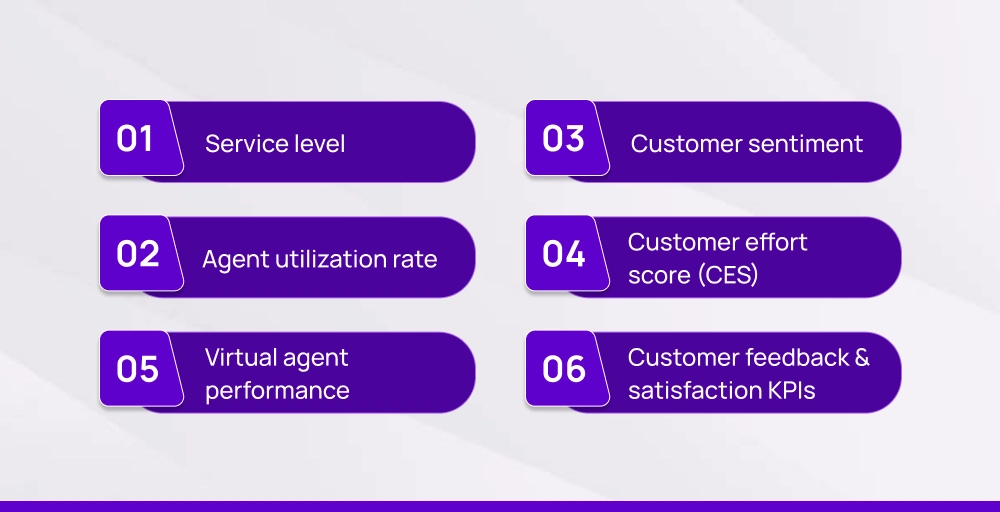
Here are the core CX metrics that you must track:
Service levels to gauge how reachable your business is for customers
Customers prefer businesses that are easily accessible when needed. When customers understand your business is easily reachable, you can build trust and make them feel cared for. That’s why companies must pay close attention to service levels.
Measuring the service level allows companies to identify the calls answered within a specific timeframe. The most common target of any business is to meet the 80/20 rule (answering 80% of calls within 20 seconds).
How well virtual agents perform to understand self-service success
Most customers attempt to resolve their issues on their own prior to reaching out to a support team. This makes providing self-service important for any business strategy. But simply implementing isn’t enough; businesses need to ensure that the self-service channels are genuinely effective.
To ensure these systems truly enhance the customer experience, you must regularly monitor and evaluate the performance of virtual agents.
When evaluating virtual agent performance, consider measuring the total number of contacts handled and the percentage of those interactions that escalate to human agents.
Customer sentiment to identify areas for improvement
Customer sentiment directly affects your success because it shows how they feel about your business. Analyzing customer sentiment enables the real-time personalization of customer interactions based on a specific customer’s mood.
During a phone call, sentiment analysis can detect a customer’s tone and language to determine if they are frustrated or upset. It allows customer service agents to tailor their responses to the customer’s emotions and needs.
You can track customer sentiment through direct feedback, surveys, social media posts, and conversations with customer service representatives.
Customer effort score to assess service ease
Customer effort score (CES) measures how easy it is for customers to resolve their issues through your contact center. This includes self-service channels, such as virtual agents or chatbots. If your business has a lower effort score, it means a smoother, more efficient experience. In contrast, a higher score signals friction points that may frustrate customers.
By consistently tracking CES, contact centers can implement data-driven changes that enhance customer satisfaction, decrease churn, and build loyalty over time.
Virtual agent performance
Virtual agent performance refers to the effectiveness with which automated systems, such as chatbots or voice bots, handle customer inquiries without requiring human intervention. High-performing virtual agents can resolve a majority of customer issues quickly, accurately, and efficiently, reducing the need for escalation to live agents.
Key indicators of virtual agent performance include:
- Resolution Rate: The percentage of interactions successfully resolved by the bot without escalation.
- Escalation Rate: The proportion of interactions transferred to a human agent, highlighting gaps in the bot’s capabilities.
- Response Accuracy: How correctly and contextually the bot addresses customer queries.
Customer feedback & satisfaction KPIs
Contact centers should proactively collect and analyze customer feedback to improve the overall experience. Gathering feedback offers valuable insights into customer perceptions, preferences, and common issues. This allows businesses to make informed decisions to enhance their products, services, and interactions.
Important KPIs to monitor from feedback include:
- Net promoter score (NPS): Assesses customer loyalty by asking how likely customers are to recommend the company. NPS is calculated by subtracting the percentage of detractors from the percentage of promoters, reflecting the overall brand sentiment.
- Average customer satisfaction (CSAT) score: Measures immediate satisfaction by asking customers to rate their experience, providing direct insight into how well interactions meet expectations.
- Response rate: Shows the percentage of customers participating in feedback surveys. Higher response rates indicate greater engagement and yield more reliable data.
How to prioritize which metric to measure
Contact centers must prioritize metrics that align with business objectives and customer needs to maximize the value of CX analytics. Focusing on the right metrics ensures that analytics drive actionable insights and meaningful outcomes.
Align to business goals
Start by defining your contact center’s strategic objectives. Whether the goal is to improve customer satisfaction, boost agent productivity, or increase retention, the metrics you track should directly support these objectives. This ensures your analytics efforts deliver real business impact.
Map to the customer journey
Identify key touchpoints in the customer journey, from initial contact to issue resolution. The metrics should capture the customer experience at these critical moments, highlighting friction points and opportunities for improvement. Prioritizing metrics in this way ensures efforts focus where they matter most.
Assign one core metric per goal type
Focus on one primary metric for each business goal to avoid spreading attention too thin. For example:
- CSAT to measure customer satisfaction
- FCR to track resolution effectiveness
- AHT to monitor efficiency
This approach keeps your measurement strategy focused and actionable.
Ensure data availability and accuracy
Metrics are only valuable if the underlying data is accurate and consistently available. Verify that your virtual call center software reliably captures the correct information so that decisions are based on trustworthy insights rather than incomplete or inconsistent data.
Set clear targets & SLA thresholds
Establish measurable targets for each metric, such as resolving 80% of inquiries within 30 seconds. Defining SLA (Service Level Agreement) thresholds helps managers quickly identify underperformance and take corrective action before it negatively affects customer experience.
Build dashboards & alerts
Create real-time dashboards to visualize your metrics and set up automated alerts for deviations from targets. This enables managers to monitor performance at a glance and respond proactively to issues, keeping service quality high.
Review regularly & refine
Customer expectations and business priorities evolve, so your metrics should too. Regularly review your tracked KPIs, refine targets, and adjust measurement approaches to ensure continuous improvement and sustained customer satisfaction.
Conclusion
Measuring the right customer experience analytics is essential for contact centers aiming to deliver exceptional service. By tracking metrics such as CSAT, NPS, FCR, and CES, and aligning them with business goals, contact centers can identify pain points, optimize agent performance, and create smoother, more satisfying customer experiences.
Regular monitoring, combined with actionable insights from analytics, empowers teams not only to resolve issues faster but also to anticipate customer needs, turning every interaction into an opportunity for loyalty and growth.
FAQs
How is customer satisfaction measured in contact centers?
Customer satisfaction is typically measured using CSAT surveys, which ask customers to rate their experience immediately after an interaction. These ratings provide a direct view of how well agents and processes meet customer expectations.
Which metric predicts customer churn best?
Net promoter score (NPS) is often the best predictor of churn, as it measures customer loyalty and likelihood to recommend the brand. Low NPS scores indicate dissatisfaction and a higher risk of customers leaving.
How often should contact centers report on FCR?
Contact centers should report on first contact resolution (FCR) monthly, though monitoring weekly trends can help identify immediate issues. Regular tracking ensures timely adjustments to improve resolution rates and overall satisfaction.

