

Call routing ensures every caller reaches the right person without long waits or repeated transfers, turning every interaction into an opportunity to build trust and satisfaction.
Whether you run a growing support team or a busy contact center, knowing how to route calls effectively is essential.
This blog covers the most common call routing methods and practical best practices to help you serve customers faster, keep agents productive, and improve overall business communication.
✨ Key Takeaways
- The call routing feature ensures every incoming call reaches the right agent quickly and efficiently.
- The process of call routing starts with identifying the caller’s intent, routing the calls to the right queues, and then distributing the calls to the right agent or department.
- There are 7 types of call routing methods: fixed order, round robin, idle time, skill-based, priority-based, geographic, and time-based routing.
- The best way to maximize your routing efforts is to combine multiple methods according to your needs.
- Efficient call routing results in a better customer experience, balances agent workloads, lowers operating costs, fewer abandonment calls, and higher FCR rates.
What is call routing?
Call routing is a feature of a business phone system that automatically queues and directs inbound calls to the most appropriate agents or departments. The incoming calls are distributed based on predefined rules, criteria, agents’ skills, or the caller’s interactive voice response (IVR) inputs.

Automated call routing functionality can be applied to businesses of all sizes to optimize their incoming business phone calls.
They can employ custom call routing strategies to ensure that every customer is connected to the right customer service agents or departments.
How does call routing work?
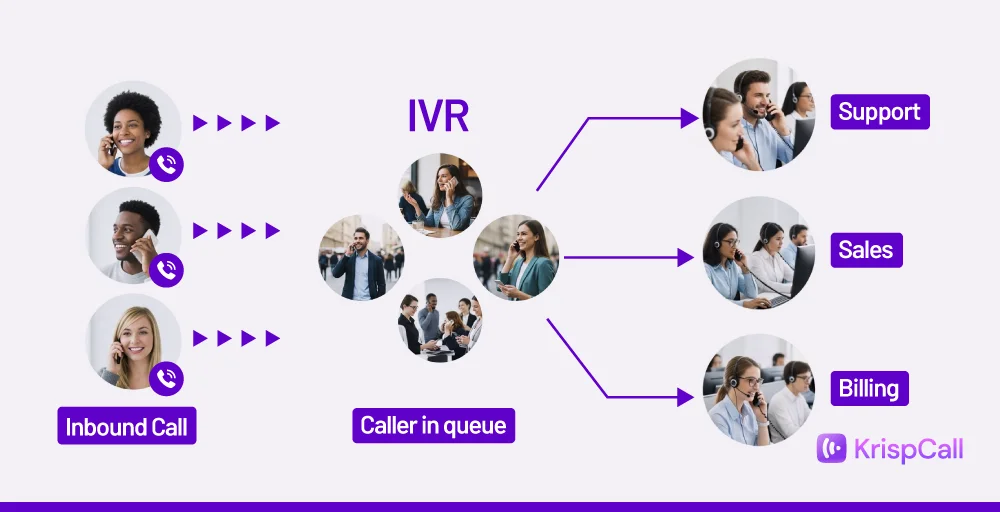
Call routing directs incoming calls to the right person or team based on specific rules. It starts by identifying the caller’s needs or inputs, then matches them with the appropriate agent or department.
The call routing process consists of 3 primary steps:
- Qualifying phase
- Call queuing phase
- Call distribution phase
1. Qualifying phase
The very first step is to identify the intent of the caller. The auto attendant systems (IVR) automatically play pre-recorded prompts and menu options, which callers respond to through a dial pad or speech input. This input from the IVR systems helps determine the intent of the callers. Sometimes the intent can also be determined by looking at the specific number or extension dialed.
2. Call queuing phase
Call routing services use automatic call distribution (ACD) to analyze the IVR inputs and all related information about the caller. The ACD routes each call to a specific queue based on pre-set rules, agent availability, and selected routing options.
3. Call distribution phase
The final step is to distribute the calls in the queue to the individual customer service representatives. The call routing system determines which departments or individuals to route the call to based on pre-determined calling rules, agent availability, and skill sets.
Types of call routing methods
Effective inbound call routing strategies ensure that customers reach the right person quickly, improving satisfaction and enhancing the overall customer journey. Here are seven widely used methods and how they work:
1. Fixed order routing
Also known as sequential or list-based routing, this method follows a predefined list of agents in a set order.
How it works:
- Calls always start with the first agent in the list (e.g., Agent A-> B -> C).
- If the first agent is unavailable, the call moves to the next agent in line.
Fixed order routing is simple to configure, but it can overburden the first agents in the queue, leading to uneven workload.
2. Round robin routing
Round robin routing distributes calls evenly across all available agents to avoid favoritism or overload.
How it works:
- Calls rotate among agents in sequence (A ->B -> C -> A again).
- Each agent gets an equal share of incoming calls over time.
This method ensures fair workload distribution and prevents burnout while maintaining consistent response times.
3. Idle time routing
Idle time routing prioritizes agents who have been available the longest or handled the fewest calls.
How it works:
- Calls go to agents with the most idle time or the lowest talk time.
- Automatic Call Distribution (ACD) tracks agent availability in real time.
Practical impact: Keeps agents engaged, reduces idle gaps, and promotes a balanced workload.
4. Skills-based routing
This method connects callers to agents who have the expertise or training to resolve their issues effectively.
How it works:
- IVR systems collect information about the caller’s needs.
- Calls are routed to agents with the matching skill set.
Skill-based routing is an attribute-based routing that results in higher first call resolution (FCR), fewer transfers, and a better customer experience.
5. Priority-based routing
Priority-based routing routes inbound customer calls based on predefined priorities such as customer status or urgency. It ensures high-value or urgent calls receive faster attention.
How it works:
- Predefined criteria, such as customer status or issue urgency categorize calls.
- Urgent calls bypass standard queues to reach top-tier agents first.
Priority-based routing improves loyalty among important customers and ensures critical issues are resolved quickly.
6. Geographic routing
Also called location-based routing, this method connects callers to agents or offices based on geographic proximity.
How it works:
- Caller location is detected through area codes, IP addresses, or IVR input.
- Calls route to the nearest available team or agent familiar with that region.
This routing method enables localized support, faster resolutions, and a more personalized experience for regional customers.
7. Time-based routing
Time-based routing directs calls according to business hours and time zones.
How it works:
- Calls route to agents currently on shift, avoiding teams that are offline.
- Especially useful for global call centers operating across multiple time zones.
This type of routing provides 24/7 coverage without disturbing off-shift agents and reduces missed calls during peak hours.
So, which one is the best call routing method?
There is no single best method. Effective call centers often combine multiple routing strategies. For example:
- Skills-based + priority routing ensures high-value customers reach the right expert.
- Time-based + geographic routing optimizes global coverage.
- AI-powered routing adds another layer by dynamically adjusting to real-time intent, sentiment, and agent performance.
The right approach depends on your business size, call volume, and customer expectations. Modern cloud and AI call routing solutions make it easy to implement a hybrid strategy for the best results.
What are the benefits of call routing?
A cloud phone system with a well-executed call routing service is the best combination to simplify business workflows and processes for call center agents, managers, and callers.
Some of the benefits of call routing include:
1. Better customer experience
Call routing instantly connects callers to the available agents or offers a callback option. The instant connection makes it easy for customers to get the help they need without long waits or transfers.
Poor call routing can lead to frustrated customers and lost business. A study shows that nearly 60% of consumers share details of bad experiences with friends and family, while 29% express their frustration on social media. Additionally, 48% of customers consider switching providers, and 39% write negative reviews.
Effective call routing helps prevent these outcomes by connecting callers quickly to the right agents, reducing wait times, and repeated transfers. This improves customer satisfaction, protects your brand reputation, and ultimately supports business growth.
2. Balanced workloads for agents
On average, industries like the contact center experience an annual agent turnover rate between 30% to 45%. A higher attrition rate increases the operating expenses and hours in new agent training.
Call routing distributes calls based on agent availability, schedules, and performance data, such as idle or talk time. This keeps one agent from becoming overloaded and reduces stress and burnout.
3. Lower operating costs
Call routing helps to decrease the cost per call by shortening hold and handling times. Efficiently distributing calls across your team also helps avoid the need to hire additional staff for peak hours.
Upgrade to VoIP and Save More
Cut costs and enhance call quality with KrispCall’s affordable VoIP system. Sign up today and see how much you can save.
Call routing improves customer retention, which is very important due to the rise in the cost of onboarding new customers, which is 25 times the cost of customer retention.
4. Fewer abandonment calls
In the era where time is important, one expects quick responses. If customers can’t reach a live agent, many will hang up.
Call routing minimizes this risk of hang-ups by reducing wait times and excessive call transfers. It also helps you optimize your agents’ availability to keep your abandonment rate low and turn more calls into resolved interactions.
5. Higher first call resolution (FCR)
Automatic call routing directly connects the caller to the most qualified and available agents in an instant. This increases the likelihood of solving their problem on the first attempt.
Improved FCR not only enhances customer satisfaction but also benefits employees with fewer follow-ups, less stress, and faster results.
Call routing in contact centers vs traditional setups
One noticeable difference between the call routing in Contact center and traditional setups lies in their efficiency, flexibility, and customer satisfaction.
1. Technology and infrastructure
Traditional setups’ call routing is usually fixed, with limited ability to adapt to fluctuating call volumes.
Cloud-based contact centers operate online and use AI call routing to adapt to their callers’ needs and agent availability automatically.
2. Flexibility and accuracy
Incoming calls in old PBX systems follow static rules like time of day or dialed extension. It involves manual call handling, leading to misrouted calls.
Cloud-based routing implements different routing strategies, like round-robin and priority-based, to ensure each call reaches the right agent on the first attempt.
3. Customer Experience
Everything is handled manually in a traditional system, which results in customers often facing long hold times. Since there are no integrations with CRM software, no caller context is shared, so they have to repeat themselves to every agent they talk to.
Contact centers utilize an intelligent routing service that shortens wait times and shares caller history with agents, which helps resolve customer issues quickly.
4. Agent productivity
In traditional setups, calls can pile up unevenly on specific agents, leading to burnout, slow response times, and high turnover.
In a contact center, calls are distributed based on live agent availability, workload, and skills. Predictive algorithms prevent overload, improving agent satisfaction and performance.
How does AI enhance call routing?
AI-driven call routing is redefining how contact centers connect customers with the right agents. Unlike static rules or traditional PBX routing, AI analyzes real-time context and caller behavior to make smarter, faster routing decisions.
- Real-time intent detection: AI-powered routing interprets why a customer is calling through IVR inputs, past interactions, or speech recognition. It understands the caller’s intent instantly and routes them to the most qualified agent or provides the right self-service option without unnecessary transfers.
- Sentiment-based routing: Modern AI solutions can detect caller sentiment, like whether they are calm, frustrated, or in a hurry, through tone analysis and keywords. With the help of AI customer service, this emotional insight helps route challenging calls to experienced agents or escalate high-priority situations automatically.
- Dynamic agent matching: Intelligent call routing considers live factors like agent availability, skills, recent performance, and workload balance to connect each call with the best-fit agent. Unlike static queues, this dynamic approach adjusts to changing conditions in real time.
Best practices for effective call routing
Some of the best practices for effective call routing that help businesses improve customer experience, reduce errors, and get the most from their contact center operations are:

1. Map out customer journeys
Understand how and why customers contact your business before building routing rules. Identify common call types (support, sales, billing, technical). Use this data to design routing flows that minimize transfers.
2. Combine multiple routing strategies
Relying on a single routing method often leads to bottlenecks or missed calls. So, mix different strategies, for example, combine skills-based with priority routing for better FCR. Always use an approach that covers both operational efficiency and provides personalized customer experiences.
3. Keep IVR menus simple and clear
Complicated menus frustrate callers and increase abandonment rates. Limit the IVR options to 3 or 5 per level and offer a “speak to agent” or callback options for flexibility. Review IVR logs regularly to identify where callers drop off and simplify those paths.
4. Monitor agent workload
Uneven call distribution leads to burnout and poor service. Use dashboards to track idle time, active calls, and queue length. Adjust your rules dynamically to balance those workloads. You can even implement AI-driven or real-time routing for automated workload optimization.
5. Continuously analyze and refine routing performance
Call routing is not a set-and-forget process. Continuously track KPIs like FCR, AHT, and call abandonment rate to gain insights. Then, use these insights to fine-tune flows and agent assignments.
Choosing the right call routing software
Here’s what to look for when evaluating call center call routing software:
1. Ease of setup and customization
The platform should let you create or adjust call flows without heavy IT support. It should have drag-and-drop call flow builders, intuitive IVR editors, and flexible routing rules.
2. Cloud-based access
Cloud routing solutions offer better reliability and remote access than traditional PBX systems. So, look for tools that require no physical hardware. The platforms should also provide for mobile agents, remote teams, and hybrid work setups.
3. Integration with existing tools
Choose software that integrates easily with your CRM and team collaboration tools. This integration allows agents to view customer history, tickets, and other details in real-time, improves conversations, and increases FCR.
4. Real-time analytics and reporting
Visibility into routing performance is essential. Look for built-in dashboards and reporting features that track call volumes, wait times, first call resolution (FCR), agent availability, workload, call abandonment, and missed call rates.
5. Scalability and pricing
Make sure the platform can scale with your team. It should provide consistent services even when you’re adding new users, launching in a new region, or handling seasonal spikes. Look for flexible pricing and also evaluate per-user and per-minute billing models.
Why is call routing essential for modern business communication?
Call routing ensures every customer call reaches the right agent quickly. It reduces wait times, prevents repeated transfers, and keeps support teams focused and efficient. For modern businesses, effective routing offers clear advantages:
- Faster resolution and higher first call resolution
- Lower call abandonment and improved customer satisfaction
- Balanced agent workload and reduced operational costs
Legacy PBX systems can’t match the flexibility and intelligence of cloud or AI-driven routing solutions. Adopting modern call routing creates a more reliable, customer-first contact center and positions your business for growth.
Explore KrispCall, a cloud-based telephony solution, to experience the impact of intelligent call routing. Book a demo now and plan your upgrade tomorrow.