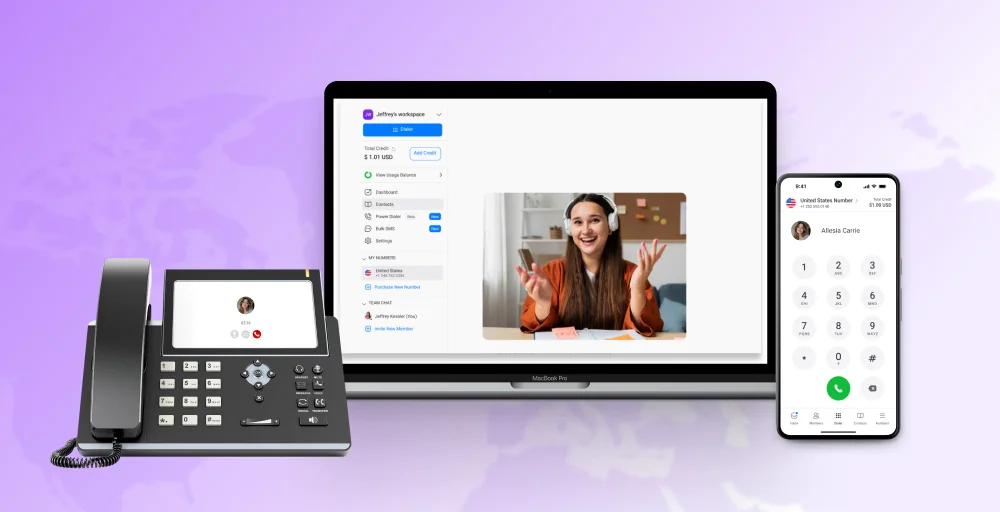



Modern business phone systems have become a staple in the industry. Cloud-based solutions like VoIP and UCaaS offer clear advantages over legacy phone systems, including cost savings, flexibility, and advanced features.
However, choosing the right system can be difficult without understanding what each offers and how they can benefit your business.
In this VoIP vs UCaaS comparison, we’ll explore both of these cloud-based communication platforms in detail, covering their key features, differences, and ideal use cases. We’re here to help you decide whether your business needs a reliable VoIP telephony solution or a full-featured UCaaS communication platform.
✨ Key Takeaways
- VoIP (Voice Over Internet Protocol) is a simple and affordable telephony solution offering modern features that surpass traditional phone lines.
- UCaaS (Unified Communications as a Service) is a comprehensive communication solution that combines multiple tools in a single unified platform.
- Despite the similarities of VoIP and UCaaS, they cover different scopes in communication and therefore have different use cases.
- Choosing the right one between UCaaS and VoIP depends on your business needs, key features, team size, and overall budget.
VoIP vs UCaaS: key differences
VoIP and UCaaS are both cloud-based communication systems that work over the internet. They’re more flexible and affordable compared to traditional telephone lines. But despite their similarities, these two technologies differ in scope, features, and cost.
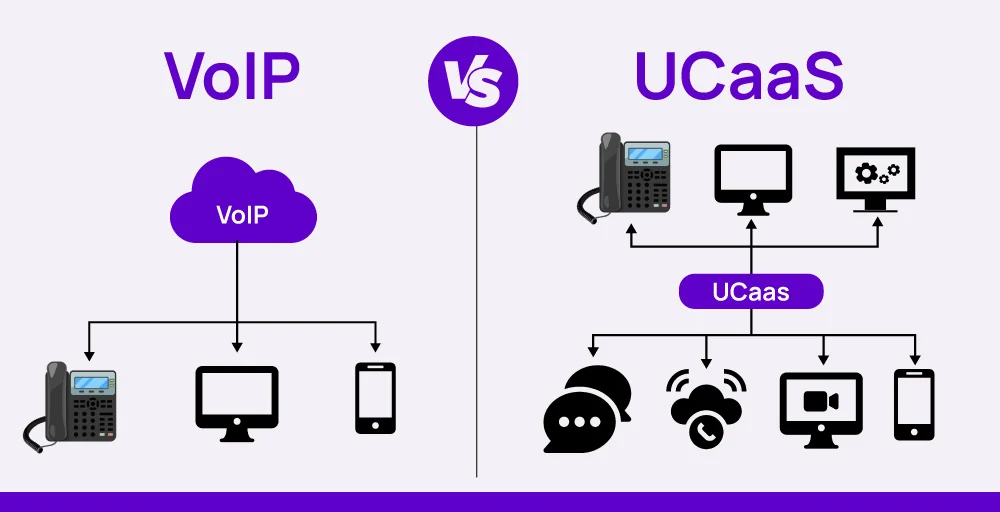
VoIP mainly focuses on voice calls and offers essential call management features. For example, call forwarding, voicemail, caller ID, etc. Because VoIP is limited to phone-related services, it is more affordable and easier to set up compared to other communication solutions.
UCaaS, on the other hand, offers a complete suite of communication tools rather than being just a simple phone service. It combines voice, video meetings, messaging, and file sharing, all in a single platform for enhanced collaboration. Because of this, when you compare VoIP vs UCaaS costs, the latter ends up being more expensive.
For more clarity, let’s take a look at the key differences of UCaaS vs VoIP below:
| Feature | VoIP (Voice over Internet Protocol) | UCaaS (Unified Communications as a Service) |
| What it does | Offers voice communication over the internet | Provides a comprehensive communication platform. |
| Supported channels | Mainly voice calls (but supports voice and text add-ons) | Omnichannel communication (Voice, video, SMS, email) |
| Features | Call forwarding, voicemail, call recording, IVR | All VoIP features and advanced collaboration tools (video conferencing, screen sharing, team chat, file sharing) |
| Integration | Supports limited CRM and CMS integration | Integrates with ERP, CRM, project management, and other business tools |
| Cost | Affordable | Costly (as compared to VoIP) |
| Ideal For | SMBs prioritizing voice communication | Large teams needing a comprehensive communication solution |
What is VoIP?
Voice over Internet Protocol (VoIP) is a communication technology that allows you to make and receive phone calls without traditional phone lines. Instead, it uses your internet connection to establish a connection and transmit voice data.

It works by converting your voice signal (analog signals) to digital data packets via an analog-to-digital converter (ADC). Then, it sends those packets to the recipient across the IP network, where they are reassembled into an analog signal for intelligible audio.
Beyond just modern communication features, VoIP also helps businesses reduce expenses. Since it eliminates the need for costly hardware and line rentals, the VoIP cost is often significantly lower than traditional phone systems.
In fact, recent VoIP studies show businesses can cut phone expenses by up to 50%, while gaining greater flexibility, scalability, and advanced features. This makes VoIP a budget-friendly upgrade from legacy systems.
What is UCaaS?
Unified Communication as a Service, often referred to as UCaaS or UC, is a cloud-based communications system that offers multiple collaboration tools and features within the unified platform. It goes beyond what VoIP typically provides, combining voice, video, instant messaging, file sharing, and more, all accessible from a single interface.
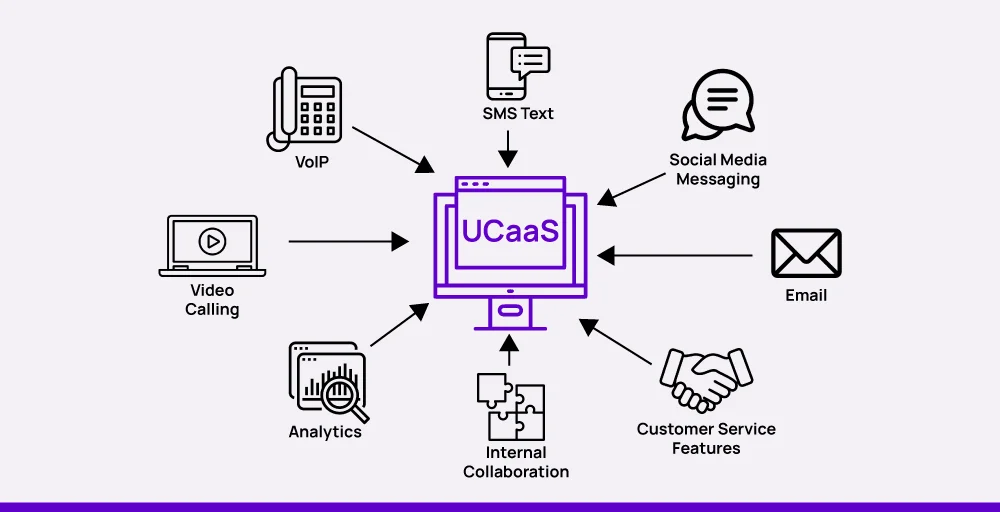
UCaaS acts as the central hub for all collaborative work. It uses VoIP technology for voice calls, WebRTC for real-time video calls, live chat, and API for more advanced features (email, file sharing, and integration with CRMs or other business software)
The comprehensive set of communication tools makes UCaaS solutions a bit more costly than VoIP. This makes them suitable for large businesses and enterprises needing an all-in-one communication system.
Feature comparison: UCaaS vs. VoIP
To better understand the difference between UCaaS and VoIP, it is essential to evaluate their key features. This will also help you determine the right system for your business.
Top features of VoIP
VoIP features mainly focus on making phone calls efficient and cost-effective.
- Phone calls: By using a VoIP phone system, you can make voice calls either through IP networks, PSTN lines, or both. It gives businesses the flexibility to preserve their existing business number and continue making phone calls via traditional lines.
- Call recording: Business phone calls with customers often contain vital information that can be missed without a proper means to store them. With VoIP, you can record these phone calls and analyze them later for insights and improvements.
- Call forwarding: With the call forwarding feature, businesses can route incoming calls to preassigned secondary phone numbers. This helps to prevent missed calls and ensure communication continuity during agent absences, disruptions, outages, etc.
- Auto attendant: Auto attendants like IVRs are designed to improve response times by assisting users without human intervention. It can guide the customers to the right department via the IVR menu and help them troubleshoot minor issues by themselves.
- Softphone support: Many VoIP providers also offer softphone capabilities with their services, allowing users to access VoIP services from any device (such as a laptop, smartphone, etc). They can make and receive phone calls, exchange text messages, check voicemails, etc, from anywhere with an internet connection.
Key features of UCaaS
UCaaS offers a complete suite of communication and collaborative tools that can fulfill the needs of any organization. Some of its key features include;
- Group messaging: The group messaging feature allows everyone in the group to communicate with each other without needing to switch between platforms. You can message privately to individuals or host a team discussion in texting channels. This helps in faster responses, allowing your team to stay updated and work in sync.
- Video conferencing: With UCaaS, you can host both audio calls and real-time video conferencing with multiple participants. The advanced collaborative feature makes it great for one-on-one meetings or group discussions.
- Integration support: UCaaS platform also allows smooth integration with your existing CRMs and business software tools. This streamlines your work by synchronizing all your essential data within the centralized platform.
- Status management: Status or presence indicators are another highlighting feature of UCaaS solutions. With it, you can set yourself as available, busy, away, and inform your co-worker of the best time to contact you.
Similarities between VoIP and UCaaS solutions
VoIP and UCaaS are both cloud-based services that allow communication over the internet. Although UCaaS solutions offer more advanced tools and features, they are both flexible, scalable, cost-effective, and can integrate well with your existing system.
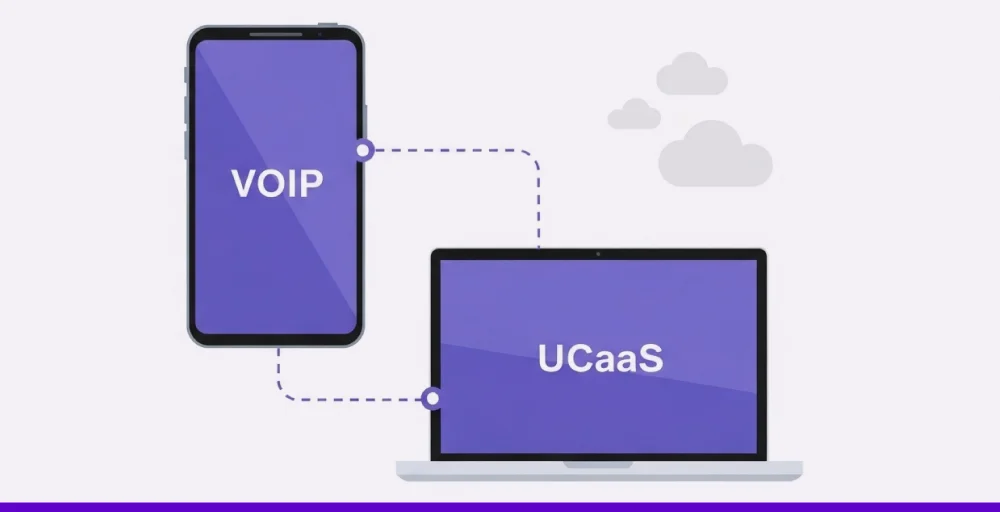
Let’s take a quick look at the similarities of VoIP and UCaaS phone systems
| Feature/Function | VoIP | UCaaS |
| Communication model | Uses the internet for voice calls | Uses IP network for voice, video, messaging, and other collaboration tools |
| Deployment | Often hosted in the cloud | Primarily delivered as a cloud service |
| Cost savings | Cost-effective than traditional telephony | Reduces costs via the combination of multiple communication tools |
| Scalability | Can quickly adjust users based on needs. | Can adjust users and services easily. |
| Flexibility | Works on mobile devices, computers, and desk phones | Works on smartphones, computers, and desk phones |
| Integration capability | Integrate with popular CRM and business apps | Supports integration with more CRMs, productivity, and collaboration apps |
| Remote work support | Allows remote calling from anywhere with internet | Support full-fledged remote communication and collaboration |
| Call management features | Offers core telephony features like Voicemail, call forwarding, IVR, etc. | Offers core telephony features and expands on them. |
When to use VoIP?
VoIP is a direct upgrade over the traditional telephone line, offering features that make communication more efficient. It performs well for various use cases, including remote working environments or teams needing advanced features without the high cost.
1. Remote work and on-the-go access
VoIP allows users to access their business communication setup from anywhere. All they need is a stable internet connection, a VoIP-enabled device, or a VoIP application installed on their personal device (such as a smartphone or laptop).
This flexibility allows employees to stay connected and be productive regardless of where they are. Moreover, you can also get dedicated virtual business phone numbers with VoIP, allowing teams to maintain professionalism and consistency.
2. Advanced communication capabilities
Businesses, mainly small to medium-sized, benefit especially from VoIP features. For instance, features like voicemail transcriptions and voicemail-to-email help to cut down response times.
Similarly, IVRs, call forwarding, or transferring can help customers to quickly reach the desired department and get faster problem resolution. Ultimately, these features help to enhance communication and improve customer experience.
3. Affordable communication setup
With VoIP, businesses can utilize their internet connection for all their telephony needs. They do not need to invest in a separate communication system. This helps reduce the high cost associated with extensive infrastructures, installation costs, and maintenance expenses.
4. Low-cost international calling
Making international business phone calls via traditional phone lines is often expensive due to costly per-minute charges. But with VoIP, you can avoid the high charges and make cheaper phone calls via the internet. It is affordable with lower rates or fixed monthly subscription fees.
5. Availability of modern phone features
One of the main benefits of VoIP over traditional lines is the advanced telephony features. Features like conference calling, auto attendants, softphone capability, and voicemail-to-email can help to make business communication more efficient.
When to use UCaaS?
UCaaS is a much bigger communication solution than VoIP, encompassing multiple advanced features and collaboration tools. It’s best for large enterprises or industries that require an all-in-one cloud-based communication platform.
1. All-in-one communication platform
Switching between multiple platforms can create inefficiencies and affect your team’s overall productivity. But with UCaaS, you can eliminate these issues by combining various channels (voice calls, video conferencing, messaging, and file sharing) in a single unified platform.It also helps to minimize your technology stack, boosting operational efficiency.
2. Consistent cross-channel connectivity
UCaaS ensures consistent and seamless communication across multiple channels such as voice, video, chat, and email within a single platform. Agents can switch from a chat to a call or even escalate it to a video meeting without losing context. This consistency helps to improve collaboration efforts and improve customer experience.
3. Collaboration support for distributed and global teams
UCaaS is also beneficial for businesses with globally distributed teams. I.e., tech companies, consultancies, call/contact centers, etc. With the platform’s ability to unify communication channels and other collaboration tools, teams can keep their work synchronized regardless of their physical location.
4. Seamless integration with business tools
UCaaS systems are capable of smoothly integrating with popular business applications like CRM, helpdesk, project management, and collaboration tools. Employees can easily access customer data, manage tasks, and handle communication within a single interface, without switching platforms. This reduces manual efforts, ensuring better team productivity and service quality.
5. Live analytics and customer engagement insights
UCaaS provides businesses with detailed real-time analytics on calls, messages, and team performance. With this information, businesses can identify trends, monitor agent efficiency, and uncover potential bottlenecks before they affect productivity.
Moreover, it helps companies to get deeper insight into customers’ behavior and preferences. This allows them to improve their service quality and make every interaction more personalized.
Choosing between VoIP and UCaaS: Which one is right for your business?
Both VoIP and UCaaS are great technologies that can enhance a company’s efficiency and productivity. But if you’re looking to pick the right one for your business, there are a few things that you must consider. Namely, they are your business needs, your team size, and the overall budget.
VoIP offers excellent value for teams that simply need a good replacement for a traditional telephone system. They’re affordable, integrate well with popular business tools, and offer all the essential telephony features to enhance business communication.
UCaaS solutions, on the other hand, are more costly than the VoIP systems, but they offer a more comprehensive set of features and tools. You can make video calls, share files, send messages, and set your presence all within a single platform. The ability to go beyond just voice calls and seamlessly integrate with a wider range of business software makes UCaaS best for large teams and enterprises.
So, to recap;
- Pick VoIP if you need advanced telephony features without the costly investment.
- Pick UCaaS if you need a reliable all-in-one communication platform and budget isn’t a constraint.
Save on communication costs without compromising features. Try KrispCall’s VoIP service today and enhance your business communication.