


The rise of the hybrid work culture has made VoIP conferencing phones an essential part of business communication. However, with so many models on the market, it can be confusing to determine which device best suits the meeting space, technical needs, and budget.
In this guide, we’ve listed the top 6 best VoIP conference phones, covering their key features, supported platforms, microphone range, audio quality, etc. We’ll also dive deep into the most important factors when choosing a VoIP conference phone.
✨ Key Takeaways
- VoIP conference phones use IP networks instead of traditional copper lines, supporting advanced features such as 360-degree microphones, wideband audio codecs, and multi-platform integration.
- Top models like Poly Trio C60, Poly Trio 8800, Yealink CP965, Yealink CP925, Cisco 8832, and Grandstream GAC2570 offer varying ranges, designs, and compatibility for different room sizes.
- Poly Trio C60 stands out with NoiseBlockAI, HD voice, and daisy-chaining for large rooms, while the Yealink CP965 combines Android OS with 13-microphone arrays for seamless voice pickup.
What is a VoIP conference phone?
A VoIP conference phone is a modern communication device used for making conference calls over the internet. Unlike traditional phones that rely on copper wires, Voice over Internet Protocol (VoIP) phones transmit voice data over IP networks to enable phone calls.
Being an internet-enabled device, you’ll often find many modern features associated with VoIP conferencing phones, such as high-quality audio, 360-degree microphones, user-friendly interfaces, and third-party platform compatibility. These features make them more versatile than analog devices, making them suitable for business meetings and group discussions.
Must have features in VoIP conferencing phones
If you’re looking to get a business VoIP phone for conferencing, it’s essential to be informed about the must-have features. This will help you better understand the device’s capabilities and get the most out of it.
- An omnidirectional microphone to capture audio from all directions. Most manufacturers offer a 360-degree microphone for the best audio coverage.
- Wideband audio support, such as G.722, Opus, or AAC codecs, for richer and higher voice quality. It ensures calls don’t feel as tiring for extended durations.
- Multi-platform integration for better versatility. This allows you to connect the device to PBX systems and/or VoIP platforms, such as Zoom and Microsoft Teams.
- High-quality speakers are also essential in conferencing phones, as you’ll often use them as the primary source of voice output.
- Reliable network connectivity with Ethernet and WiFi connectivity support for seamless and secure communication.
Why trust KrispCall’s reviews?
For years, we’ve been helping thousands of businesses find the right communication tools, and we understand how much a poor buying decision can cost in time, money, and productivity.
To support better decisions, we’ve reviewed hundreds of VoIP products and business communication tools across categories. In the process, we’ve analyzed thousands of verified customer reviews from platforms like G2, Capterra, and TrustRadius, alongside real user discussions on Reddit and Quora.
Every article we publish is written and reviewed by humans, with a clear focus on what businesses actually need. No sponsored placements. No inflated rankings. Just research-backed insights you can act on.
Learn more about our content update process, content integrity standards, and software review methodology.
Top 6 VoIP conference phones
With multiple options available on the market, it can be tricky to choose the best conference phones that suit your needs. But fret not, we’ve done our research and gone through multiple VoIP conferencing phones thoroughly (including Polycom, Yealink, Cisco, etc).
Based on the features, pros, cons, and pricing, we’ve compiled a list of the 6 best VoIP-enabled conference phones.
| VoIP Phones | Suited For | Microphone Range | Supported Platforms | Audio Quality | Connectivity |
| Poly Trio C60 | Medium to large room (6–12 participants) | 20 ft, 360° coverage | Zoom, Teams, Webex, RingCentral, SIP PBX | Wideband (100 Hz–22 kHz), Poly HD Voice, NoiseBlockAI | Dual-Band Wi-Fi (2.4/5 GHz), Bluetooth 5.0, USB 2.0, Gigabit Ethernet (PoE) |
| Poly Trio 8800 | Large room(8–20 participants) | 20 ft, 360° coverage | Zoom, Teams, Webex, Skype, SIP PBX | Wideband (100 Hz–22 kHz), Poly HD Voice, Acoustic Clarity | Dual-Band Wi-Fi (2.4/5 GHz), Bluetooth 4.2, USB 2.0, Gigabit Ethernet (PoE) |
| Yealink CP965 | Medium to large room(6–15 participants) | 20 ft, 360° coverage | Teams, Zoom, Webex, SIP PBX | Wideband (Opus, G.722), Noise Proof, full-duplex | Dual-Band Wi-Fi (2.4/5 GHz), Bluetooth 4.2, Gigabit Ethernet (PoE), DECT for wireless mic expansion |
| Yealink CP925 | Small to medium room (4–8 participants) | 20 ft coverage | Teams, Zoom, SIP PBX | Wideband (Opus, G.722), Smart Noise Filtering | Dual-Band Wi-Fi (2.4/5 GHz), Bluetooth 4.2, Gigabit Ethernet (PoE), USB 2.0 Type-C |
| Cisco 8832 | Small to medium room(4–8 participants) | 10 ft (expandable to 20 ft) | Webex, Cisco UC, SIP PBX | Wideband (G.722), echo cancellation | No Native WiFi support, Gigabit Ethernet (PoE), DECT for optional wireless mic expansion |
| Grandstream GAC2570 | Medium-sized room(6–12 participants) | 16 ft, 360° coverage | Hangouts, SIP PBX, Android OS | Wideband (Opus, G.722), full-duplex | Dual-Band Wi-Fi (2.4/5 GHz) with with 802.11ax (Wi-Fi 6), Bluetooth 5.0, Gigabit Ethernet (PoE), USB 2.0 |
Aside from the 6 best VoIP conferencing phones mentioned above, here are a few honorable mentions.
- Poly SoundStation IP 7000
- Poly Trio 8300
- Yealink CP935
- Konftel 300W
- Mitel 6970
1. Poly Trio C60
The Poly Trio C60 by HP is undoubtedly one of the best conference room phones available right now, thanks to its multitude of useful features and excellent coverage, making it well-suited for any size conference room.
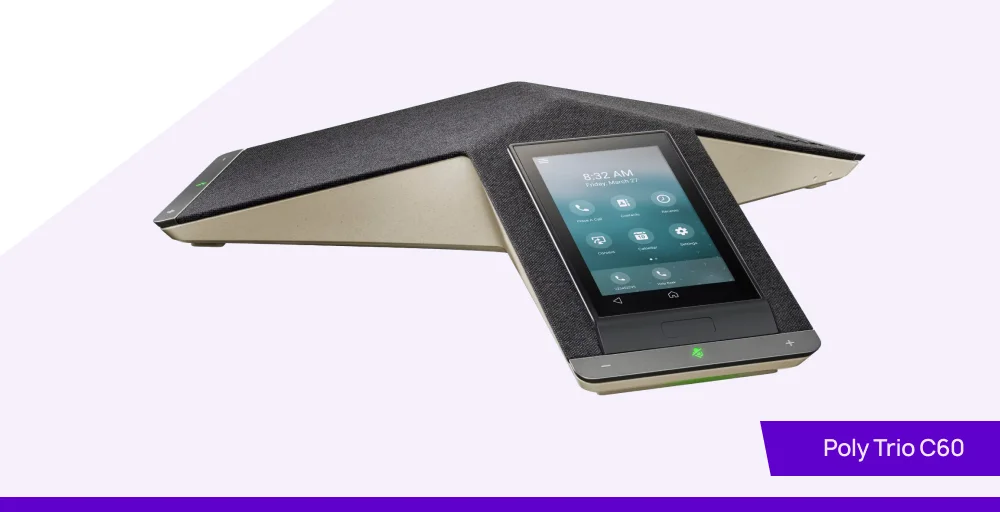
It offers exceptional audio quality (Poly HD Voice and NoiseBlockAI), an easy-to-use touchscreen display, and broad platform support for professional hybrid meetings.
Granted, the pricing is relatively expensive compared to others, but if you want a modern conference phone that can do it all, the C60 is a solid pick.
Best features
- Poly Acoustic Clarity technology for the higher audio quality.
- NoiseBlockAI for background noise suppression.
- 5-inch colour touchscreen LCD.
- Daisy-chaining (up to 3 devices) for maximum coverage.
- Optional video integration via add-ons.
| Pros | Cons |
| Wide platform support | Comparatively expensive |
| Top-notch audio quality with noise suppression | Complicated platform switching process |
| Daisy-chaining support | Daisy-chanining is only available with other C60 |
| Touch screen interface | Lacks an integrated power supply (Battery) |
Price
The Poly Trio C60 IP conference phone pricing fluctuates between $300 and $500, depending on the vendor and different online retailers. For an accurate estimation, you’ll need to contact the sales department.
2. Poly Trio 8800
Although the Poly Trio 8800 is a relatively older model than the Trio C60, it remains a high-end flagship device designed for large conference meetings. It features the same Polycom signature audio quality, along with NoiseBlok, and a 360-degree microphone that covers up to 20 feet.
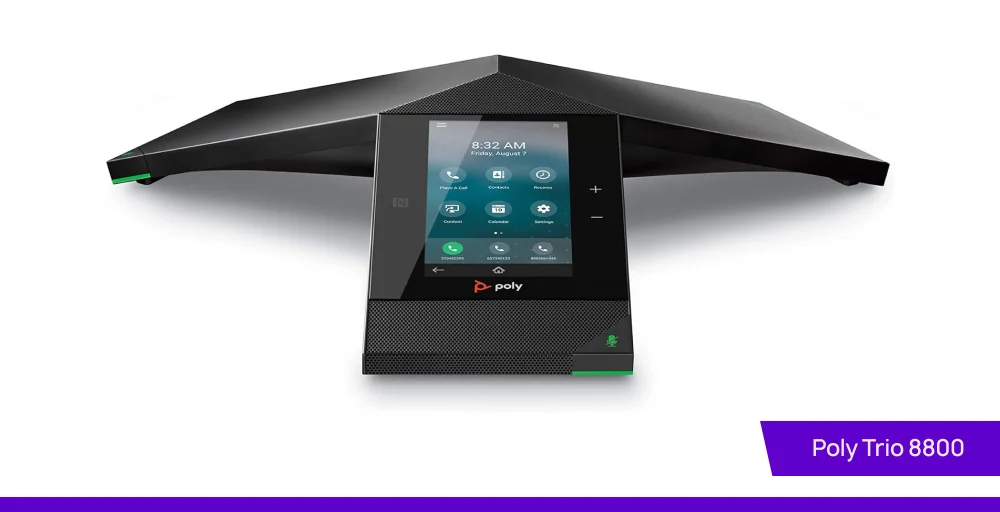
If you’re looking for an enterprise-grade conference phone with similar specs to the C60 but at a lower price point, the legacy 8800 can be a great option.
Best features
- Poly HD Voice with Acoustic Clarity.
- Full duplex, echo cancellation, and noise reduction.
- Video conferencing and content sharing support (via Poly Visual+ or EagleEye add-ons)
- Intuitive 5-inch color touchscreen display.
- Built-in Wi-Fi, Bluetooth, and USB support.
- Compatible with platform (Zoom, Teams, Webex) and SIP-based PBX systems
| Pros | Cons |
| Suitable for large conference halls | The initial setup process can be complex |
| Excellent sound quality | Somewhat unreliable POE switch |
| Expandable microphones | Availability issues due to discontinuation |
Price
The typical price of the Trio 8800 ranges from $200 to $500, and the availability solely depends on the online retailers (such as Amazon or IPPhoneWarehouse)
Note: If you’re going for the Poly Trio 8800, we recommend selecting one with built-in Microsoft Teams support. The legacy version was designed primarily for Skype for Business, which is now discontinued.
3. Yealink CP965
The Yealink CP965 is the company’s flagship VoIP conference phone system, directly competing with the Poly Trio C60. Design-wise, both of the phone systems look pretty similar, but they offer slightly different features.
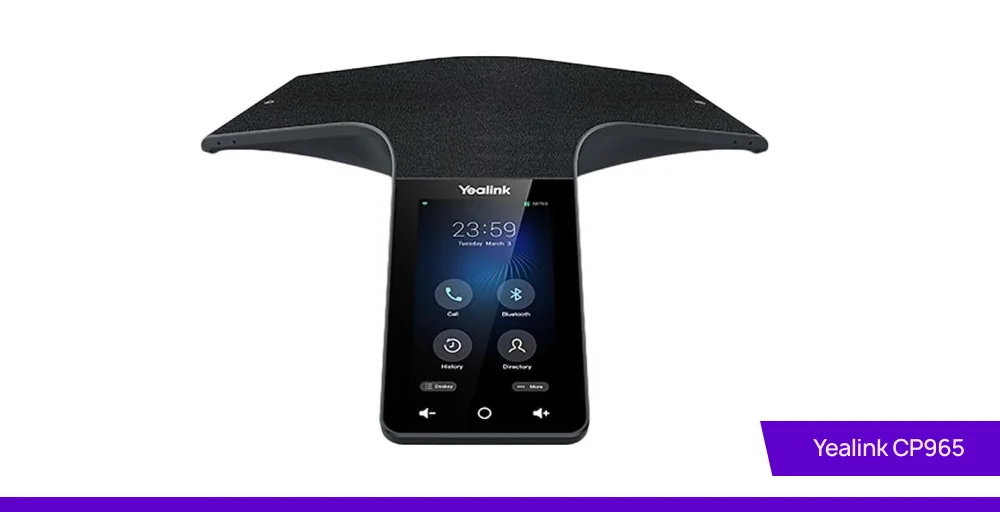
The CP965 offers a well-rounded, rich audio quality, all thanks to its Optima HD Voice and Smart Noise Filtering features. The 13-array microphone can easily pick up voices from anywhere within a 20-foot proximity. Moreover, the device runs on an Android-based platform, allowing for firmware updates, a more intuitive user interface, and smoother third-party app integration.
Despite concerns regarding the long-term reliability of usage (as some users have reported), the CP965 remains an excellent choice from Yealink.
Best features
- Features Android 9.0 operating system
- Yealink Noise Proof Technology with Smart Noise Filtering.
- Full-duplex speakerphone with AEC.
- Built-in 13 noise-cancelling microphone array, 360-degree voice pickup.
- Offers a DECT wireless expansion microphone.
| Pros | Cons |
| Exceptional audio quality | Lacks an integrated power system |
| Uses Android OS for futureproofing and timely updates | Reliability concern for long-term usage as compared to the predecessor model, CP960 |
| Daisy-chaining up to 3 devices | Lacks video-conferencing support |
Price
The Yealink CP965 is priced between $500- $800. The final price largely depends on the B2B partners and the online reseller.
4. Yealink CP925
Yealink CP925 is the direct successor to one of the most robust conferencing phone systems, the CP920. We’re replacing the CP920 with the CP925 due to the discontinuation of the legacy model. Plus, the newer system also introduces a handful of new features and improvements over the older one.
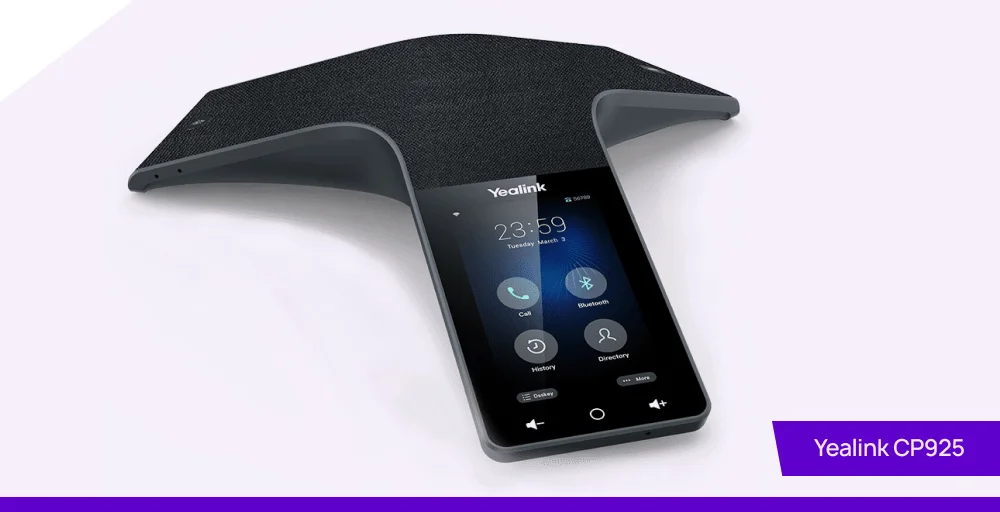
The most notable change is the sleek design, which now resembles that of the flagship CP965. As for the features, you’ll get an improved microphone array with omnidirectional voice pickup (ideal for small to medium-sized conference rooms), enhanced noise filtering technology, and connectivity options, among others. The larger touch-sensitive display is also a major upgrade from the previous generation.
Best features
- 4-inch capacitive touch screen.
- Optimal HD audio with Smart Noise Filtering.
- 7-microphone array with 360° voice coverage.
- Wi-Fi and Bluetooth support
- Robust multi-layered VoIP security features.
| Pros | Cons |
| Crystal clear audio quality | Lack of daisy-chaining capability |
| Support hybrid UC meetings | Limited to 5-way conferencing |
| Affordable pricing | Requires an external power source |
Price
The Yealink CP925 is priced between $400 and $600.
5. Cisco 8832
Cisco IP 8832 conference phone is a professional-grade VoIP conferencing device designed for small to medium-sized meeting rooms. It offers excellent wideband audio, a 360-degree coverage microphone, and extended coverage with its wired microphones.
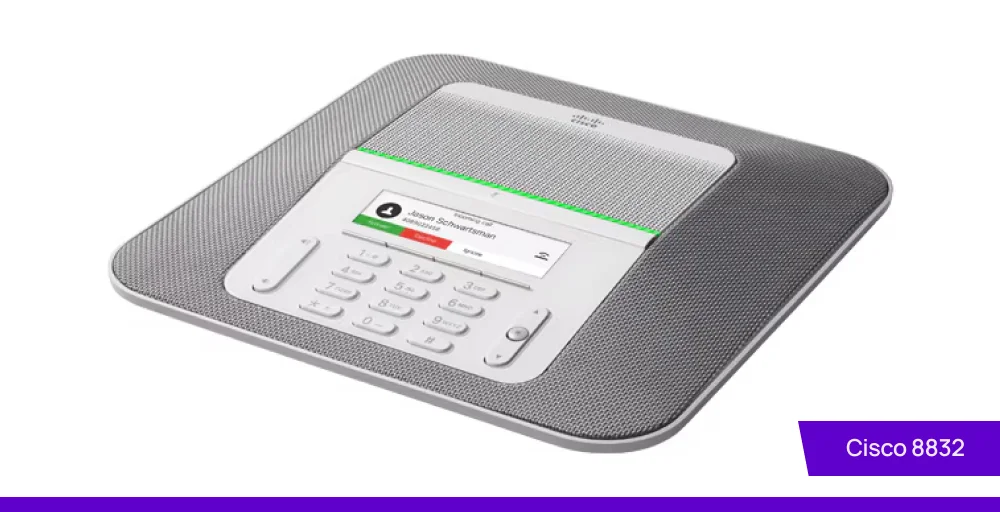
The simplistic modern design, intuitive interface, and compatibility with Cisco UC systems and SIP platforms make this phone a reliable option for businesses that are already using the Cisco ecosystem.
Best features
- Studio-monitor speaker with wideband audio (G.722) for crystal-clear sound
- Omnidirectional microphone coverage up to 10 ft. (expandable)
- Color LCD and intuitive touch key for call control and management.
- Multi-platform support for Cisco Webex, SIP-based PBX, and third-party UC systems with strong encryption for secure communications.
| Pros | Cons |
| Excellent audio quality | Lack of native Wifi connectivity support and other third-party VoIP platform |
| Compatible with Cisco Unified Communications Manager, Webex, and third-party SIP platforms | Complex setup process in non-Cisco platforms |
| Enterprise-grade encryption | Lack of built-in power (Battery) |
Price
To get an accurate price for the Cisco 8832, you’ll need to contact the sales team.
6. Grandstream GAC2570
The Grandstream GAC2570 is a modern VoIP phone system suited for medium sized teams. It is an Android-based system that offers an intuitive touchscreen display with robust audio system. With support for SIP and third-party apps, it fits well into most business communication setups.
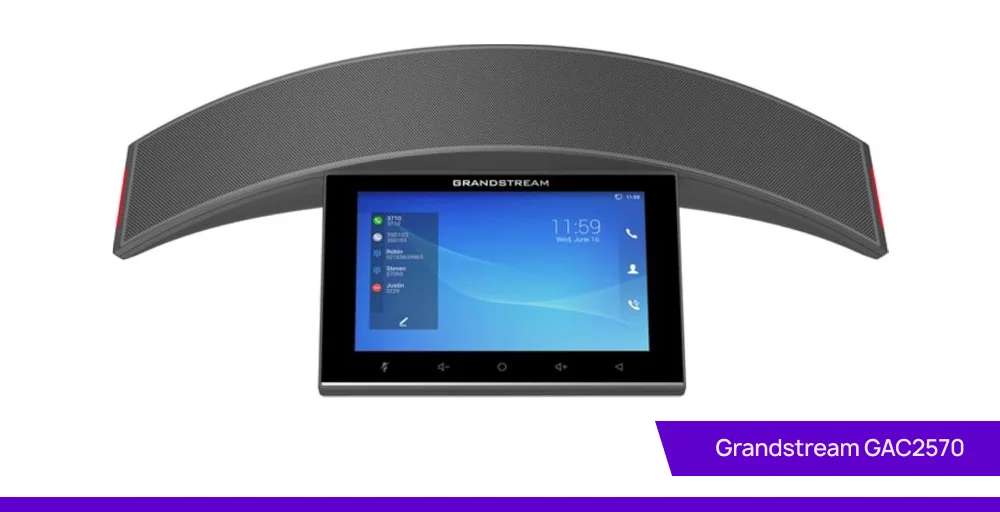
Best features
- 7-inch touchscreen display
- 12 omnidirectional microphones with MMAD (Multichannel Microphone Array Design)
- Full-duplex speaker with HD acoustic chamber
- Support for SIP and Android 10
- Support for Dual-Band Wi-Fi, Bluetooth 5.0, Gigabit Ethernet
| Pros | Cons |
| Android-based OS | The user interface can feel complicated |
| Built-in call recording capability | Occasional firmware glitches |
| Supports 12-party conferences | Lacks the video integration support |
Price
To get an accurate price for the GAC2570, you’ll need to contact the sales team.
Benefits of VoIP conference phones
VoIP conference phones offer several advantages, ranging from being cost-effective to improving the quality and efficiency of your business meetings. Here are a few of its notable benefits:
- Reliability: As dedicated phones are solely used for conferencing, they offer enhanced VoIP security and are typically more reliable than a softphone. They ensures you always have a reliable and straightforward way to conduct meetings rather than switching apps on your computer or connecting multiple telephones.
- Audio clarity: Conference phones are designed with speakers that provide the best audio quality and omnidirectional microphones that reduce background noise. This ensures voices are heard clearly during meetings, making them more effective.
- Simplified call management: Modern conference phones often feature an intuitive touch screen display and dedicated mute buttons to manage conference calls. This eliminates the need for additional VoIP phone equipment or software (softphones) and simplifies call management.
- Integration support: Many VoIP conference systems have dedicated support for the popular unified communications platforms such as Zoom, Microsoft Teams, Webex, etc. This integration support allows you to conduct meetings regardless of the platform without additional software installation.
- Connectivity flexibility: These phones can connect in multiple ways to suit different business setups, such as Ethernet wire (POE), WiFi connectivity, Bluetooth connectivity, USB support, DECT technology, etc.
Which VoIP conference phone is right for you?
To help you pick the right VoIP conference phone, we’ve listed them based on different criteria as follows;
- Best for small to medium conference rooms (4–10 participants): Yealink CP925, Cisco 8832
- Best conference phones for large rooms (8–20 participants): Poly Trio 8800, Yealink CP965, Poly Trio C60
- Best for budget-conscious buyers: Grandstream GAC2570, Yealink CP925
- Best for wireless VoIP conference phone: Cisco 8832
- Best for integration support: Poly Trio C60, Poly Trio 8800, Yealink CP965, Cisco 8832
- Best for usability: Yealink CP925
How to choose the right VoIP conference phone?
When choosing a VoIP conference phone, there are several key factors that you need to consider, such as:
Determine your needs
Ensure that the conference phone you pick is able to cover the conference area sufficiently. If it’s a relatively smaller group (4-6 participants), a basic phone with a decent microphone range will be sufficient.
However, if there’s more than 12-15 participants, you’ll need a higher-end phone system with omnidirectional microphone coverage, expandable microphone capability, or even daisy-chaining for even more range. Choosing the right size ensures clear communication for all attendees.
Prioritize audio quality
Good audio quality, powered by advanced VoIP codecs is the foundation of conference phone systems. Look for systems that offer wideband audio support such as full-duplex HD voice, solving echo problems, and background noise suppression (e.g. NoiseBlock or Acoustic Fence). They ensure sharp, natural conversations, reduce listener fatigue during long calls, and boost meeting productivity.
Choose the right connectivity options
There are different ways to power the conference phone system. For a more grounded and fixed connection, it is better to opt for Power over Ethernet (POE). Here, the Ethernet wire will offer both power and an internet connection to the device.
If portability is your main priority, it’s better to opt for models that are powered via battery. Moreover, some models also offer the ability to connect headsets via a USB connection or via Bluetooth for more convenience.
Check the Integration Support
Make sure the VoIP conference phone supports the platforms your team already uses. Whether it’s Microsoft Teams, Zoom, Webex, or SIP-based systems, this compatibility ensures a smooth workflow without additional setup or third-party tools. Some models offer built-in platform support, whereas others offer flexible switching.
Emphasize usability
When picking a VoIP conference system, make sure that it aligns with your workflow. Meaning, opt for modern conference phone systems that offer a touchscreen interface for intuitive navigation and more control. Some models even have integrated Android operating software for even more application support and features.
Consider your budget
Conference phone systems don’t necessarily have to be expensive to get the most out of them. If you have small to medium teams, you’ll be better off going with the budget-friendly option. They have all the essential features and offer a great overall value. But if your team is quite large, requires a lot of features and future proofing, only then will you need to invest in the more expensive options.
Best alternatives to VoIP conference phones
Although conference phone systems are the primary solution for business meetings, there are a few alternatives that you can use as well:
- Conferencing Software/apps: These are dedicated software or applications that have audio and video calling capabilities. They do not need dedicated conference phone systems but instead work off your existing hardware, like smartphones, laptops, etc. For example, Zoom, Microsoft Teams, Google Meet, etc.
- Speakerphones: VoIP speakerphones are essentially a more compact version of conference phone systems. They are portable and more cost-effective, making them perfect for smaller team meetings. For example, Poly Sync 20+, Nearity A21S, Jabra Speak2 75.
- Cloud conferencing platforms: Cloud-based VoIP services and unified communication platforms go beyond simple audio conferencing. They offer a complete communication solution integrating features like voice conferencing, call recording, routing, virtual number, messaging, among others. They run on existing devices like computers or smartphones, eliminating the need for dedicated phone systems.
Conclusion
There are a lot of VoIP conferencing phones on the market, and you don’t have to be a tech expert to choose the right one for your team. The key is to consider your meeting needs, team size, and the features that matter most to your workflow.
Whether it’s a cost-effective option for smaller rooms or a more advanced model for larger teams, you’ll find a suitable solution from the above list for every type of business setup.