

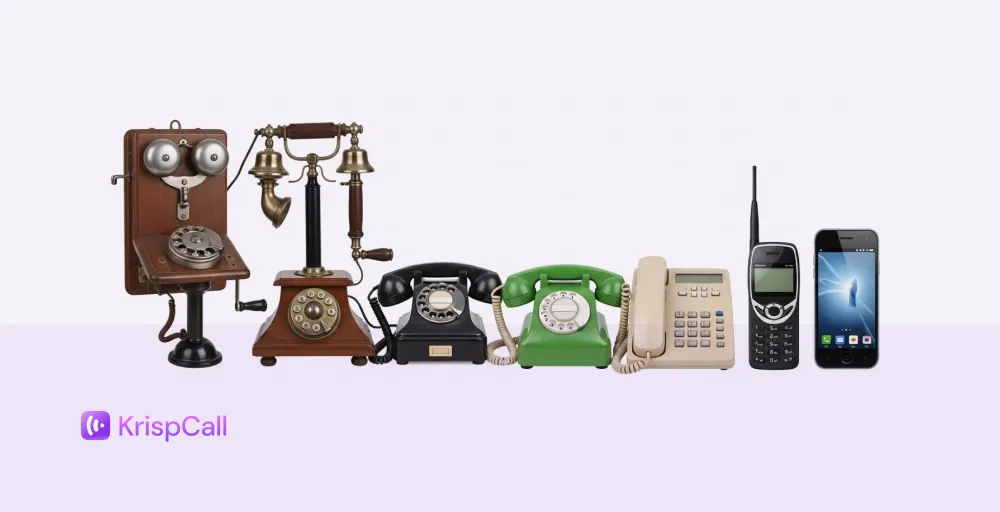
The telephone has come a long way. From crackling voices over copper wires to AI-powered smartphones that fit in your pocket.
But why does understanding this evolution matter in 2026? Over 97% of the global population owns a mobile phone, and for more than half, it’s their main gateway to the internet.
As phones continue to evolve and reshape how we connect, looking back at their journey helps us understand where we’re headed next.
In this blog, we’ll walk you through the evolution of the telephone—from its invention in 1876 to the smart devices we rely on today.
Before the Telephone: What Existed Before 1876?
Before the telephone became known in history, people relied on primitive yet ingenious methods to communicate across distances.
One of the earliest forms was the acoustic telephone, invented by Robert Hooke. Sometimes, it was also known as the ‘Lover’s phone’, which transmitted sound to a short distance via vibrations using a taut string.
As the need for long-distance communication grew, inventors turned to visual methods. In 1792, French inventor Claude Chappe invented the Semaphore lines. It is a system of towers with pivoting arms (or blades or paddles) that transmit visual signals over long distances.
A major breakthrough came in the 1830s with the invention of the electric telegraph. It revolutionized long-distance communication by sending messages through wires using Morse code, regardless of visibility or terrain.
Despite these innovations, communication was far from seamless. The acoustic method had a range of just a few hundred feet, Semaphore towers were slow and vulnerable to the weather, and electromagnetic telegraphs required trained operators and could only transmit text in code.
During this period, inventors also experimented with devices like the electromagnetic telephone. These early technological developments laid the groundwork for the evolution of telephone service, but they couldn’t deliver real-time, person-to-person voice interaction. That missing link is what sparked the race to the evolution of phones.
The Invention Era (1876–1900)
1. The first practical Telephone
Alexander Graham Bell revolutionized communication with the invention of the first telephone service in 1876. Known as the “harmonic telegraph,” this early electrical telephone converted vocal or other sound waves into electrical signals using a diaphragm and coil, making real-time voice conversations possible for the first time.
Just days later, he made the first historic telephone call to his former assistant Thomas Watson, famously saying, “Mr. Watson, come here, I want to see you.”
However, Bell wasn’t the only one racing to bring voice transmission to life. Inventor Elisha Gray also submitted a similar patent application on the very same day at the patent office. But, Bell beat him by mere hours, sparking one of history’s most debated patent disputes. By 1877, the Bell Telephone Company had been formed, laying the groundwork for the first telephone service in the United States.
2. Early Telephone Models
As demand grew, new models emerged. The top box, introduced in 1879, was one of the first phones designed for both home and business use. By 1880, the Gower-Bell Telephone brought cleaner sound and greater durability, gaining traction across Europe and Asia. The introduction of the carbon microphone in the late 1870s significantly improved voice quality and transmission range.
These designs helped make telephone technology more mainstream and reliable, with early adopters including businesses, wealthy households, and stock exchanges that needed instant communication for trading.
3. From Operators to Automation
Towards the end of the century, manual switchboards allowed people to connect over long distances, but they relied on live operators. Users weren’t connected directly to their intended recipients but had to go through centralized switching points.
The reliability with operators changed with Almon B. Strowger’s invention of the automatic telephone exchange system. It also introduced the concept of ‘direct dialing’ and set the stage for the modern telephone network.
The rotary dial system was not adopted by the Bell system until the 1920s, even though it was patented by Strowger in 1891.
The Rise of Telephone Networks (1900–1950)
The beginning of the 20th century marked several significant milestones in the evolution of the phone timeline. Telephone exchanges and switchboards became the backbone of communication, connecting homes and businesses through centralized networks.
Operators routed calls manually to connect users across cities and eventually countries. By 1927, the first transatlantic phone call between New York and London marked a milestone in global long-distance connectivity.
AT&T grew into a powerful communications monopoly in the United States with Bell Labs. The Kingsbury Commitment in 1913, an agreement between the U.S government and AT&T, allowed AT&T to continue its expansion while also ensuring the growth of independent phone companies.
In the 1920s, Rotary dial phones began replacing operator-assisted calls, thanks to Almon Strowger’s earlier invention. Users could now dial numbers directly, which made the whole communication faster and private. Still, manual operators were needed to operate calls in rural areas, but automated switching systems began to take over urban centers.
During both world wars, the telephone proved to be a strategic asset. Military command centers would use telephone lines for quick decision-making and real-time updates. This period also saw the rapid development of two-way radios, such as walkie-talkies. Wartime demand became the catalyst for the development of telephone infrastructure, especially in logistics, intelligence, and emergency services.
The Analog to Digital Shift (1950–1980)
The development of the telephone took a significant turn with the arrival of touch-tone dialing. It quickly replaced the familiar rotary dial with a faster, more accurate system built on dual-tone multi-frequency (DTMF) signals.
By the late 1970s, the focus on convenience intensified, which brought digital cordless phones and answering machines into the mainstream. This era also gave rise to portable phones, offering users the freedom to move around the house while talking. Although still limited in range, these early wireless handsets foreshadowed the coming revolution in mobility.
Around the same time, business communication was being reshaped by the rise of private branch exchange (PBX) systems. PBX systems laid the foundation for today’s VoIP solutions and auto-dialer software.
This trend continues as traditional landline phones evolve into internet phone services, offering greater flexibility, scalability, and cost efficiency for both personal and professional use through IP telephony solutions and VoIP technology.
The Mobile Revolution Begins (1980–2000)
In 1983, communication changed forever when Motorola made history by releasing the DynaTAC 8000X, the first cell phone that was commercially available and handheld. Weighing 2 pounds and offering just 30 minutes of talk time, it was bulky and expensive, but it marked the dawn of true wireless communication with the first mobile phone call placed by engineer Martin Cooper.
In 1974, the landmark antitrust case United States v. AT&T was filed. This case led to the breakup of the Bell System in 1982. With this, the Bell monopoly ended, and the market was opened to competition, encouraging innovation and investment in emerging technologies.
As technology advanced, the 1980s and ‘90s saw the rise of pagers, car phones, and the first generation of cellular phone networks. Analog systems transitioned into digital standards like GSM and CDMA, which made mobile communication more secure, efficient, and scalable. GSM’s 1991 debut in Finland led to its global adoption, while CDMA gained popularity in North America.
The 1990s also saw the birth of the smartphone era. While the term “smartphone” wasn’t widely used at the time, IBM’s Simon, released in 1994, is considered the first device to combine a mobile phone with PDA features, such as a calendar and touchscreen. The release of the first camera phone in 2000 further revolutionized mobile technology, transforming how people communicate, capture moments, and interact with the world.
Smartphones Take Over (2000–2020)
The early 2000s marked a turning point in mobile phone history. Devices like the BlackBerry brought email and secure messaging to professionals, making phones essential tools for business on the go.
In 2007, Apple introduced the iPhone, combining a sleek touchscreen design with a powerful app ecosystem. It redefined what a mobile device could be. Android followed closely with the T-Mobile G1 in 2008. It then opened the door for a wide range of smartphones at different price points and fundamentally changed the market.
Throughout the next decade, smartphones grew smaller, stronger, and easier to use. Google’s Android operating system became the world’s most widely used mobile platform, powering billions of devices across different manufacturers and price ranges. This shift opened doors for businesses, boosting demand for mobile app development services in USA to meet growing mobile-first needs.
With more advanced apps available, one device in your pocket could now handle messaging, web browsing, email, and countless other tasks—turning phones into personal hubs for everything from banking to streaming to booking a ride.
All these developments led to traditional landlines and basic feature phones beginning to fade. Home phones gathered dust as families went fully mobile. Carriers shifted their entire business models to data plans, and the payphones became relics of a different era. By the end of the 2010s, smartphones weren’t just popular, they were essential to modern life.
Cloud Telephony and VoIP (2020–2026)
The shift to cloud-based communication has accelerated rapidly in the 2020s, driven by the need for flexibility, cost savings, and support for remote work. Major tech companies headquartered in San Francisco and Silicon Valley have been at the forefront of this transformation, developing innovative cloud communication solutions.
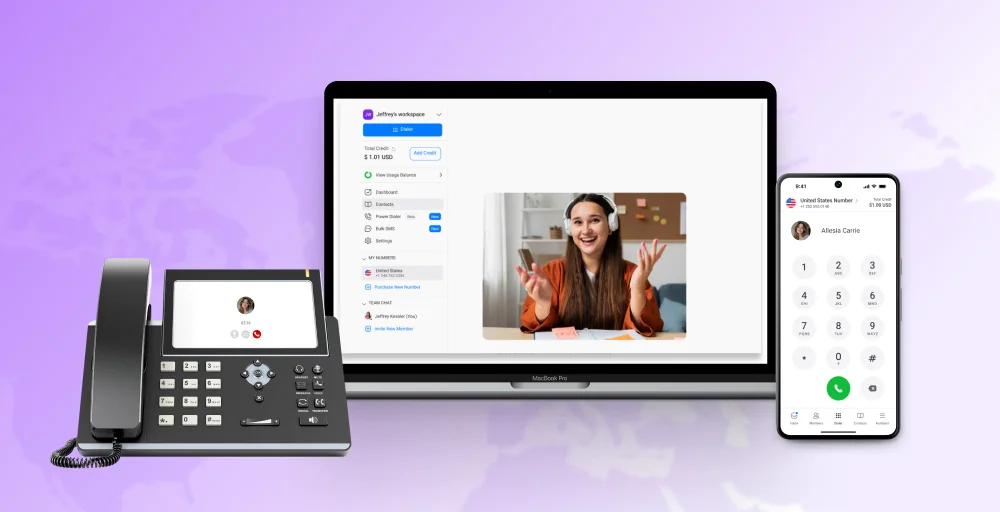
Businesses are moving away from outdated POTS (Plain Old Telephone Service) and replacing bulky on-site hardware with cloud-based PBX systems like hosted VoIP that scale effortlessly and integrate with modern workflows.
Businesses switching to voice over IP can save between 30% and 50% on their phone bills, depending on their size and previous setup.
Call center platforms like KrispCall are at the core of this movement, offering global reach and significant cost savings along with other features such as:
- AI-powered assistants that handle routine inquiries.
- Smart routing that gets the customer to the right person at the right time.
- Advanced caller ID features that not only display the incoming phone number before answering but also help users decide whether to take or ignore the call.
- Virtual phone numbers that let you build a local presence in multiple countries without physical offices.
Moving to the cloud isn’t just an upgrade in technology. It’s a fundamental shift in how businesses connect with the world. As more companies continue to migrate to the cloud, telephone systems are quickly becoming a thing of the past.
The Future of Phone Technology: What’s Next?
The future of phone technology is as bright as the sunlight. AI-powered voice agents are becoming capable enough to manage complex tasks like customer negotiations and appointment scheduling. When combined with real-time language translation, voice communication could soon erase global language barriers.
Satellite calling, powered by innovations like Starklink-enabled phones, promises true global coverage. It does not require any cell tower. Remote regions, oceans, and disaster zones will finally have reliable voice access, transforming emergency responses and off-grid communication.
Looking ahead, 6G will push boundaries even further. With ultra-low latency and blazing-fast speeds, it will power the Internet of Everything (IoE), which powers not just phones, but vehicles, appliances, wearables, and more. Voice will become just one part of a seamless, intelligent communication web that’s always on and always connected.