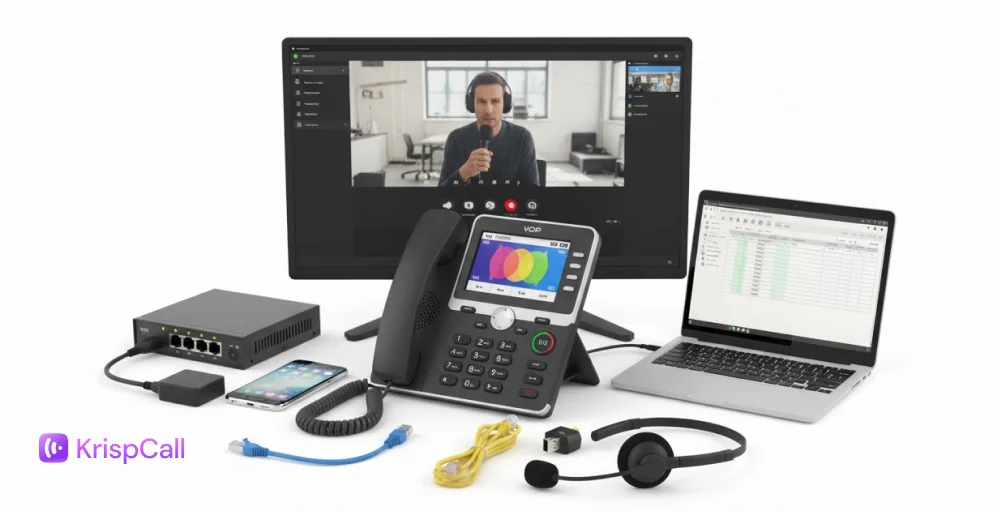



Is your outdated and unreliable phone system holding your business back? Missed calls, unstable connections, and confusing setups can frustrate your team and disappoint your customers, affecting growth and productivity.
Let’s step into smarter, more reliable communication with fixed VoIP. It combines internet-based calling with the credibility of a fixed, physical address, offering the flexibility of modern systems with the assurance of traditional lines.
Whether you’re upgrading your current setup or exploring new options, knowing how Fixed VoIP works will help you make a smarter decision.
In this blog, you’ll learn what exactly fixed VoIP means, how it works, its pros and cons, and when to choose it for your business.
✨ Key Takeaways
- Fixed VoIP numbers are linked to a specific physical location, such as a business office or a home.
- Fixed VoIP phone system offers consistent call quality, enhanced security, lower international calling costs, and support for emergency service.
- A fixed line number is ideal for businesses that operate from a permanent location, need reliable emergency service access, strong security, and require both call and text flexibility.
What is fixed VoIP?
A fixed VoIP phone number is a virtual number that is tied to a particular physical address. It is an internet-based phone line that is assigned to a residential or a company’s office.

Fixed VoIP numbers are generally suitable for businesses that have a fixed physical location and are looking for a solution with traditional landline features but greater flexibility and lower cost via VoIP (Voice over Internet Protocol) technology.
These numbers offer several VoIP features that make it a reliable and feature-rich alternative to a traditional phone system. The core features include call forwarding, call queues, voicemail, call recording, voicemail transcriptions, and conferencing.
How does fixed VoIP work?
Fixed VoIP works by routing the phone calls over the internet instead of traditional copper lines. Before your call travels over the internet, the system uses the Public Switched Telephone Network (PSTN) to confirm your assigned physical address.
Then, when you make a call, your voice is converted into digital data packets that travel over the internet. At the other end, those packets are converted back into sound, allowing recipients to hear in real time.
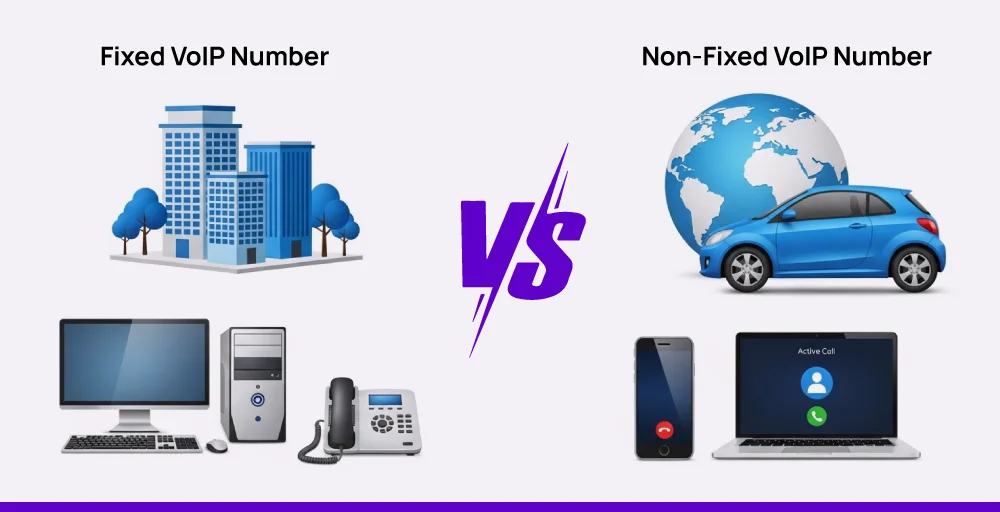
How does fixed VoIP differ from non-fixed VoIP?
Before comparing the differences between fixed and non-fixed VoIP, let’s first have a look at the similarities they share.
- Both depend on an internet connection to operate
- Work with the same types of devices and VoIP phones
- Allow to send and receive phone calls and text messages
- Offer similar features and integration options
- Both are portable and scalable
While both fixed and non-fixed VoIP let you make calls over the internet, they are different when it comes to setup, location, and security. Most VoIP users choose one over the other based on which factors matter most for their operations.
Here is a side-by-side comparison table of fixed vs non-fixed VoIP numbers in terms of cost, call quality, location requirement, portability, security, setup, international calling charge, and more.
| Factors | Fixed VoIP | Non-fixed VoIP |
| Address association | Tied with physical address | Not tied to a physical address |
| Call quality | Generally stable due to fixed network setup | Can be lower or inconsistent due to dependency on the internet connection and location |
| Cost | Higher due to initial setup and ongoing costs | Lower due to minimal setup and maintenance costs |
| Security | High: low chance of fraud | High if measures are implemented |
| Portability | Limited to the registered address | Highly portable; works anywhere with internet access |
| International calling charge | Expensive | Affordable |
| Emergency service | Provide emergency support with accurate location information | Limited or not supported; location may not be accurate |
| Set up | Longer and complex | Easy and quick |
| Best for | Business with a fixed physical location | Businesses that need flexibility, easy setup, and affordable international calls |
The main difference between fixed VoIP vs non-fixed VoIP phone numbers is the address association. Let’s see how fixed is different from non-fixed VoIP in detail:
Fixed VoIP solution specifics
Fixed VoIP phone service makes your business appear local in a particular place. It offers stable call quality and top-tier security due to a fixed network setup. These numbers provide reliable emergency service support with accurate location details.
On the downside, tied numbers have limited portability since they must remain registered to that specific address. It makes it hard to expand your business globally. They usually come with higher costs because of more complex installation and ongoing maintenance. An international and long-distance call with a fixed number is also expensive.
It is ideal for businesses with a fixed physical location that value consistent call quality and security.
Non-fixed VoIP solution specifics
Non-fixed VoIP numbers are location-independent and offer greater portability and flexibility. They have generally lower setup and maintenance costs and can be used anywhere with internet access.
Call quality can be inconsistent sometimes, depending on the internet strength and location. International calls are more affordable. However, emergency services may not be reliably supported because location information isn’t always accurate. If you have a non-fixed business number, you can register your business listing on Yelp, Bing, and Google Business Profile.
Non-fixed numbers are better suited for businesses that need a local phone number and prioritize easy setup, flexibility, and cost-effective international calling.
Pros and cons of fixed VoIP numbers
Fixed VoIP numbers have both benefits and drawbacks that businesses should consider before choosing them:
Pros of a fixed VoIP number
Fixed VoIP numbers offer several key benefits for businesses that enhance security, flexibility, and reliability:
- High security: Fixed numbers are hard to spoof or use for malicious purposes. It makes it easy to track down if anyone engages in fraudulent activities.
- Access to emergency services: These numbers make it easy to trace the location, which helps to route the VoIP calls to the appropriate and nearest emergency call center during emergency cases.
- More versatile than a landline phone number: Unlike landlines that can’t receive text messages, fixed VoIP lines support both text messages. In addition, it allows you to set the caller ID information effortlessly.
Cons of a fixed VoIP number
Despite their advantages, fixed virtual phone numbers also come with some restrictions and limitations:
- Limited to a specific location: A tied VoIP number is limited to the specific location you registered it with. This means you can’t easily use it if you move or want to make calls from a different location.
- Complex setup: Fixed VoIP has an advanced setup, which involves connecting your landline system through SIP trunking. This can require IT expertise, making it harder for non-technical teams to manage.
- Expensive international calls: As fixed VoIP is tied to a physical location, international calls may go through traditional routes instead of internet-based routes. This can charge you higher calling charges for international calls.
When to choose a fixed VoIP number for your business communication?
A fixed VoIP number is ideal for your business if you want to prioritize reliability, security, flexibility, and consistent customer experience.
You can choose a fixed virtual number for your business communication under the following conditions, more specifically:
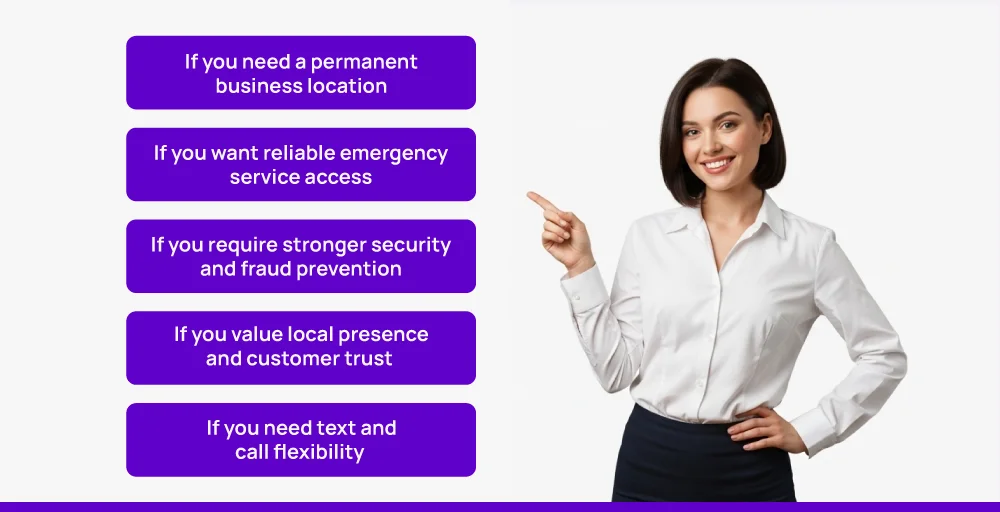
1. If you need a permanent business location
If your company operates from a fixed address, such as an office, retail store, or call center, a fixed VoIP number is the right choice for your business. It makes your business look more credible and established. It helps to build trust with customers and other business partners.
2. If you want reliable emergency service access
With fixed VoIP, your address is registered with E911 services. It ensures that you receive help quickly through the emergency responders. These numbers are crucial in industries like healthcare and hospitality, where emergencies must be addressed without delay.
3. If you require stronger security and fraud prevention
Businesses that handle sensitive customer data or financial transactions should use the fixed VoIP number because these numbers require address verification and identity. It reduces the risk of number spoofing, scams, unauthorized access, or other security threats.
4. If you value local presence and customer trust
A fixed VoIP number helps your business appear established in the community. It builds trust with local customers and engages them. This can be especially useful for service-based businesses, professional offices, and businesses targeting a specific region.
5. If you need text and call flexibility
Permanent VoIP numbers let you handle both calls and texts (SMS/MMS). You can respond to calls through your desk phone, cell phone app, or computer without juggling multiple lines. It ensures consistent and timely interactions.
Get a fixed VoIP number with KrispCall!
If you are looking for a reliable, professional, and secure telephony service, KrispCall offers a fixed VoIP number. With it, you can get a fixed VoIP number in minutes and enjoy high-quality calls, advanced features, 100+ CRM integrations, and 24/7 customer support. Plus, you safeguard your accounts and authenticate accounts with 2FA and OTP verification.
Ready to experience it yourself? Sign up for KrispCall and start using your VoIP number instantly.
Frequently Asked Questions
Can I port my existing number to fixed VoIP?
Yes, you can port your existing number to fixed VoIP through the process called phone number porting. However, it depends on the phone number provider and the VoIP providers.