

Most businesses choose a phone system the wrong way.
They compare feature lists, get a demo, pick the cheaper option, and sign a contract before they’ve asked the one question that actually matters: What happens to our operations when this system fails?
The choice between an on-premises and a hosted cloud phone system has real consequences for how your team works, what your IT department carries, and what you pay, not just at setup but also three and five years from now.
Getting it wrong doesn’t announce itself immediately. It shows up gradually in maintenance bills, in remote employees working around limitations, and in a scaling process that takes weeks when it should take hours.
This guide covers what both systems actually demand from your business, not just what they offer.
✨ Key Takeaways
- On-premises systems require in-office setup and management, whereas hosted cloud systems are maintained externally by providers.
- You need to make a significant upfront investment in an on-premises phone system, while a hosted system offers affordable, subscription-based pricing with no hardware costs.
- Scalability and flexibility are major advantages of hosted VoIP, enabling remote teams to connect seamlessly from any device.
- Choosing the right system depends on your business size, budget, technical resources, and preference for control or convenience.
What is an on-premises phone system?
A premise-based phone system is a telephony setup physically located within a company’s business locations. All hardware, including servers and the traditional PBX system, is located on-site.
Depending on the system, it might involve analog phone lines or using on-premise IP phones to transmit calls over an internet connection.
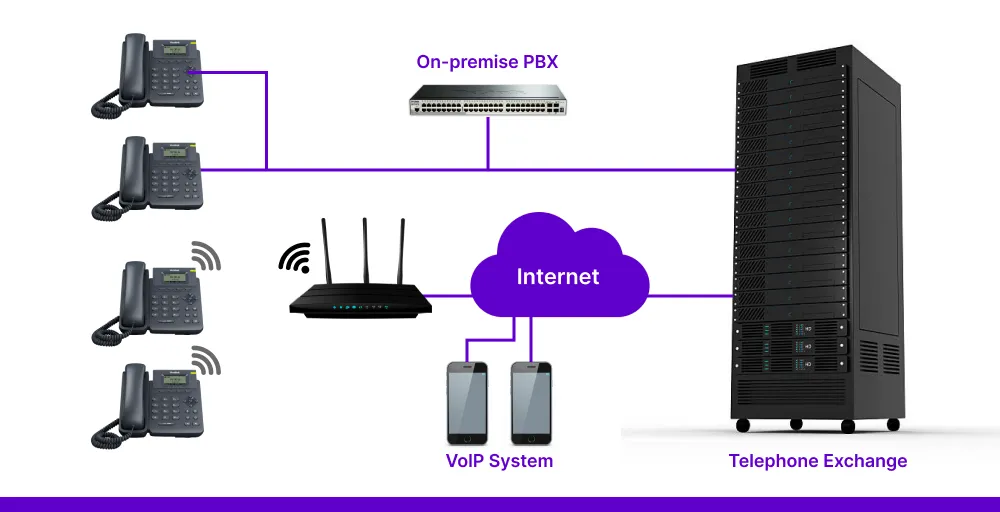
This setup gives businesses full ownership and complete control over their telephony infrastructure.
However, that control comes with responsibilities, such as purchasing and installing the hardware, managing data storage, and having IT staff for upkeep.
As everything is tied to a physical location, an on-premises phone system limits flexibility. All employees must be on-site to use the system, which can be a disadvantage for remote or hybrid teams.
What is a hosted cloud phone system?
A hosted cloud phone system is managed off-site by a service provider and runs through an internet connection.
Instead of installing and managing hardware on your premises, everything from phone calls to voicemails is handled in the cloud, using Voice over Internet Protocol (VoIP).
One of the strongest appeals of a hosted phone system is its flexibility.
Teams working across different locations or working remotely are not tied to a desk. They can stay connected as long as they’ve got compatible VoIP software running on their devices.
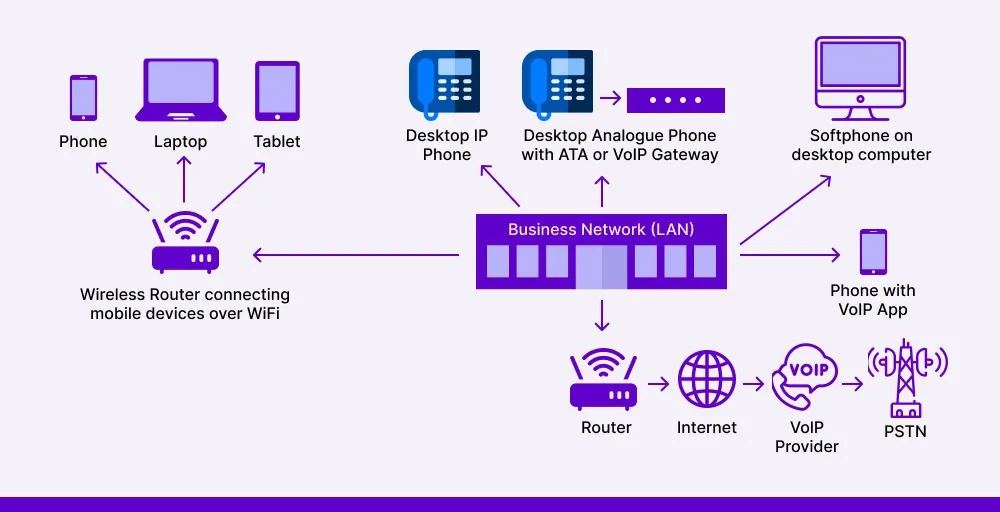
The setup of a hosted VoIP system is faster, eliminating the upfront costs of purchasing and installing hardware. It also enables easier scaling without requiring major infrastructure upgrades or complex wiring.
Key differences between on-premise and hosted systems
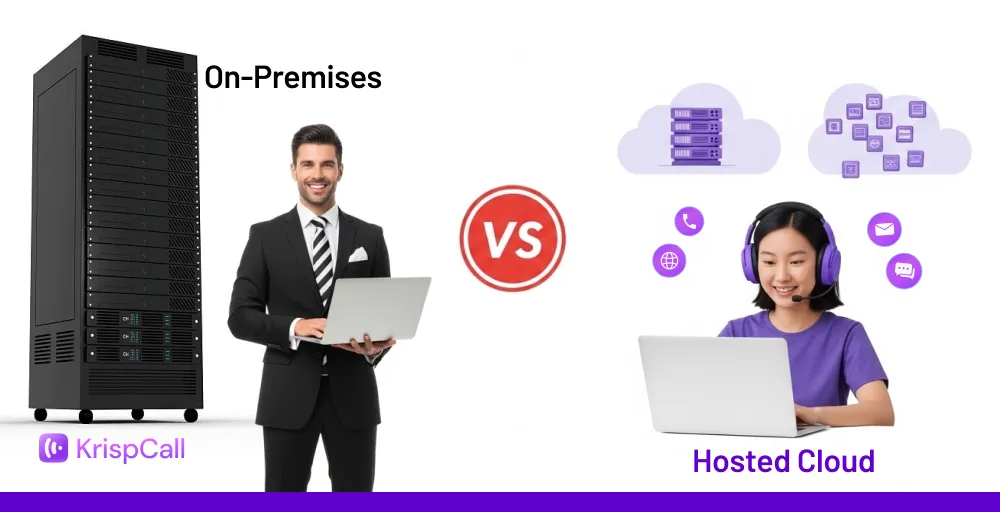
Here is a breakdown of the major differences between hosted vs on-premise phone systems, helping you compare their setup, costs, scalability, and maintenance needs.
| Factors | On-premises phone system | Hosted phone system |
| Cost | High upfront and ongoing maintenance costs. | Lower initial cost with monthly subscription-based pricing and a predictable monthly fee. |
| Scalability | It is hardware-dependent and has low scalability. | It is easily scalable and offers a remote-friendly setup. |
| Maintenance | The maintenance responsibility is In-house. | It is managed by a third-party provider with minimal internal effort. |
| Reliability | Less reliable due to local system vulnerabilities | Highly reliable, especially for remote workers |
| Security | Businesses have control over security measures | Provider-managed security protocols, compliance, and encrypted business communication. |
1. Cost comparison: On-premises vs. Hosted cloud
An on-premise phone system is expensive to operate because it requires a large upfront investment in hardware, installation, space, and a dedicated IT staff. Over time, repair costs, system upgrades, and hardware replacements can significantly add to the total expense.
A hosted solution, on the other hand, is hosted by a third-party provider, removing the need for on-site physical infrastructure.
But you have to pay for a recurring subscription fee, which covers access to the entire system, maintenance, and updates.
2. Scalability and flexibility
Scaling an on-premises phone system is slow and expensive. For each new user, you need to add new hardware, modify your network configurations, and configure your installations, creating a bottleneck for businesses that grow quickly.
A cloud-based phone system adapts quickly, offering flexibility to add or remove users without any infrastructure changes.
The remote workforce and distributed teams on this system can connect easily through any IP phone or device.
3. Maintenance and support
With an on-premise setup, the business itself is responsible for all system maintenance. From software updates to hardware malfunctions, everything must be handled internally or through paid service contracts.
By comparison, a hosted VoIP system shifts all maintenance and support responsibilities to the provider.
Software updates, performance monitoring, and bug fixes are all managed by the service providers themselves.
4. Reliability
Your on-premise phone system is as reliable as your local infrastructure. Power outages, hardware failures, or network issues can bring the system down, halting all telephony conversions until the issue is resolved.
A hosted phone system typically operates across multiple data centers, featuring built-in failover and backup protocols. If one of the servers goes offline, another automatically takes over, ensuring calls and features continue without interruption.
5. Security: Which system is safer?
Businesses gain full control over their data and security protocol with an on-premise VoIP system. While this control can be appealing, it also means the company must handle every aspect of cyber protection, including setting up firewalls, monitoring for intrusions, and performing data backups.
Cloud providers invest heavily in securing their networks, often using advanced encryption, redundant firewalls, and continuous monitoring. A hosted PBX provider typically offers compliance support for industries with strict data regulations.
Related 👉: Top Small Business Phone Systems
Which one is better for your business?
Choosing between an on-premises and a hosted phone system depends on your current business operations and future plans. Costs, team setup, growth objectives, and technical preferences all influence the decision.
Choose an on-premises system if:
- You require full control over your telephone system, including internal servers, security settings, and call forwarding rules.
- You have an in-house IT team capable of maintaining hardware, applying updates, and handling potential disruptions.
- Your business operates primarily from a central location with little to no remote workforce.
- You’ve already invested in traditional phone systems infrastructure like an on-premises PBX or server room and prefer to manage everything on-site.
- Long-term ownership outweighs your concern for higher upfront costs and ongoing technical upkeep.
Choose a cloud phone system if:
- You have a distributed or remote workforce that needs flexible access to the phone system from anywhere.
- You want to reduce upfront costs and move to a predictable, subscription-based pricing model.
- Your internal IT resources are limited, and you’d prefer the provider to handle maintenance, updates, and scaling.
- You’re planning to grow your team or expand your contact center and want to add users without hardware upgrades.
- You need a fast setup with tools that work across mobile phones, business phone systems, desktops, or even retrofitted devices via a VoIP adapter.
How to choose a phone system?
Before you decide on a cloud-based phone system and an on-premise solution, here is a list of key factors to consider:
- Assess reliability history: Reliable call quality and uninterrupted service are essential, especially if you’re managing a contact center or remote teams. So, look for a provider with consistent uptime and minimal service interruptions.
- Verify compliance and certifications: Ensure the provider meets key standards like ISO/IEC 27001, SOC-2, and PCI. If your business handles sensitive data, such as in healthcare, confirm that the hosted VoIP provider is HIPAA compliant.
- Evaluate security practices: Ask about their security protocols, data encryption, and vulnerability reporting process. A trustworthy provider should be transparent about how they protect your telephony network.
- Check for essential features: Ensure the VoIP phone systems offer tools that support productivity, such as voicemail-to-text, call recording, real-time analytics, and integration with your PBX or CRM.
- Request a demo: Before committing, schedule a live demo to explore phone system features. This allows you to explore the interface, ask questions about setup and support, and confirm the system aligns with your business operations.