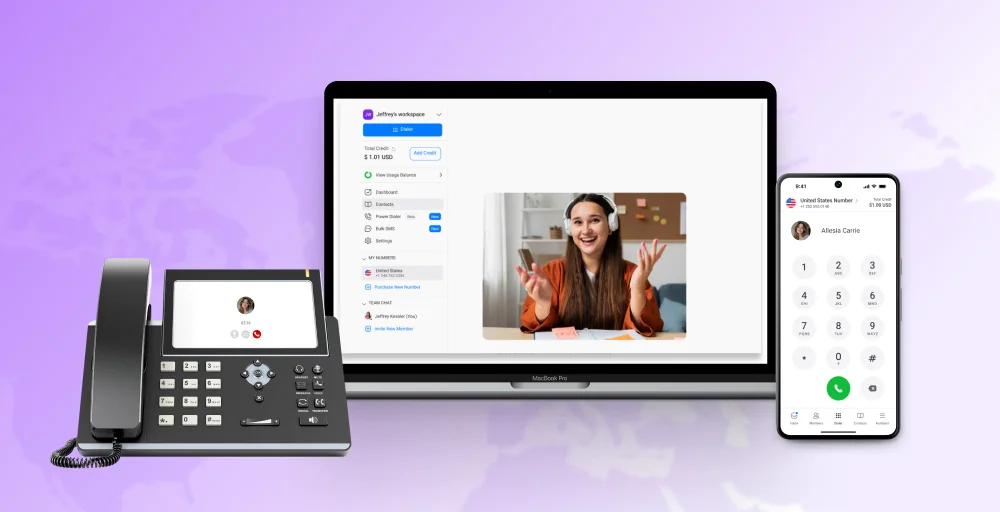


With the imminent shutdown of PSTN lines, it is now crucial for businesses to switch to modern communication solutions. Companies that relied on traditional landline phones will soon need to adapt to continue functioning.
This is where a VoIP gateway comes in. It’s a device that connects old phone systems with modern IP-based communication solutions, allowing businesses to transition smoothly without replacing their existing setups.
In this blog, we’ll walk you through what VoIP (Voice over Internet Protocol) gateways are, how they work, and how they benefit businesses.
✨ Key Takeaways
- VoIP gateway connects analog communication systems with IP-based communication solutions to save costs, ensure security, and support modern VoIP features.
- There are different types of gateways, each suited for different purposes, such as analog gateways, digital gateways, hybrid gateways, and SBC.
- Call routing and forwarding, standard codec support, failover, and redundancy support are some of the key features that VoIP gateways offer.
What is a VoIP Gateway?
A VoIP gateway is a device that enables communication between the traditional Public Switched Telephone Network (PSTN) and the modern IP-based networks. It works by converting analog signals into digital packets and vice versa, making communication seamless between the two systems.
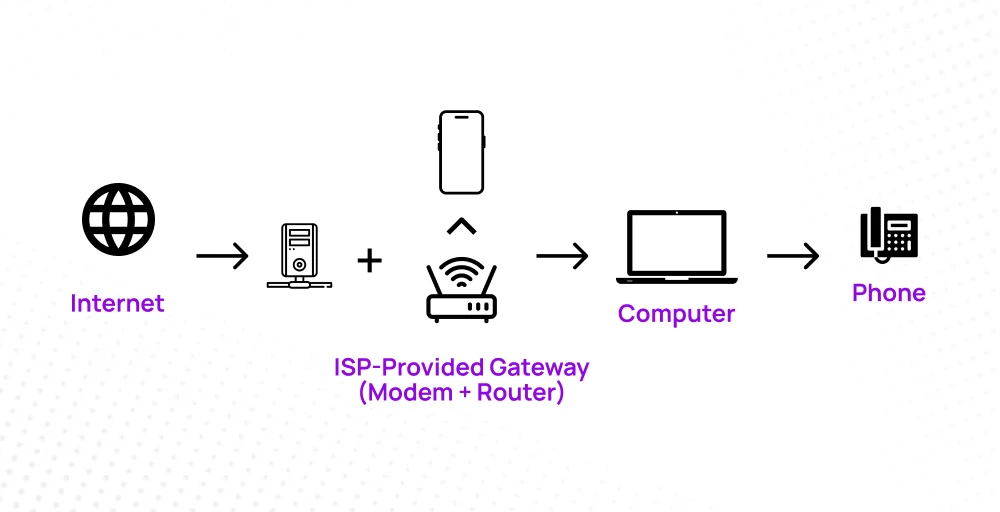
Not only does this give business VoIP service on their existing analog telephone system but it also makes transitioning to a modern VoIP phone system much easier and cost-effective.
For instance, companies that still rely heavily on legacy systems like desk phones, fax machines, paging units, intercoms can continue to function smoothly by simply adding a media gateway device. It can be integrated for just a single device, or a department, location, etc.
How does a VoIP Gateway work?
VoIP gateway device enables seamless data transfer between analog and digital systems by converting analog signals into digital data packets and vice versa.
To set it up, you’ll need to connect all your device ports, SIP trunks to the gateway’s network IP. Afterwards, the gateway then handles signal conversion, packet compression, and call routing in sequence.
Here’s a step-by-step explanation of how that works.
1. Analog-to-digital conversion
When you use a traditional telephone to make a phone call, the gateway receives the analog signal and converts it to a digital data packet. This translation allows the data signals to be transferred over the IP network and processed by modern communication systems.
2. Encoding and decoding
After the conversion process, the gateway compresses the digital packets via VoIP codecs like G.711 or G.729. This makes data transfer efficient and requires less bandwidth. Afterwards, these digital packets are decoded back into analog signals so that they can be sent through the PSTN line and understood by the recipient.
3. Call routing
VoIP gateways can also be configured to route calls using the best path available. It evaluates and uses either the PSTN line or the VoIP network based on different factors such as traffic volume, time of day, destination, etc. This ensures all your calls are consistent, reliable, and cost-effective.
4. Protocol translation
Older generation telephones often lack the native protocols necessary for SIP or H.323 communication. A VoIP gateway fixes this issue by translating data between circuit-switched protocols in legacy systems and packet-switched protocols in VoIP systems.
Types of VoIP Gateways
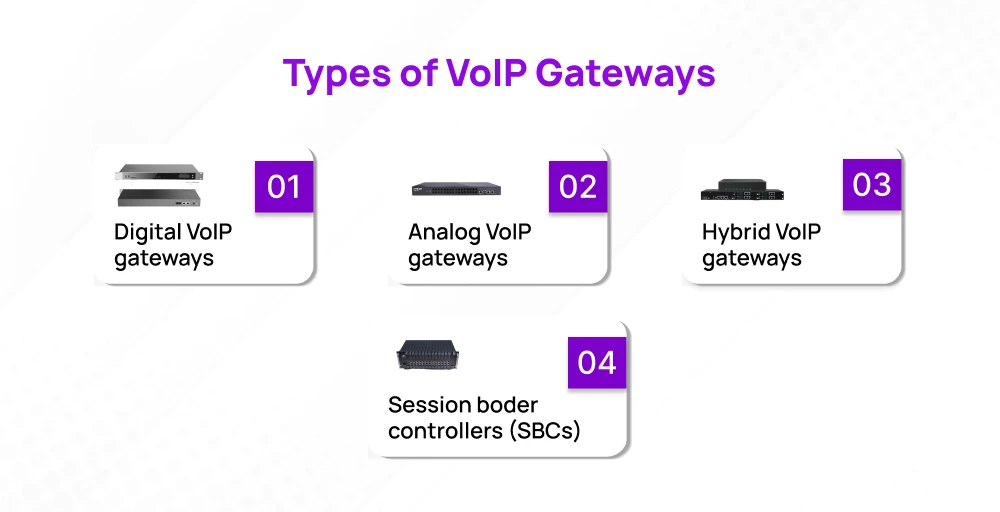
There are multiple types of voice gateways, each suited for different infrastructure configurations and purposes.
1. Digital VoIP gateways
Digital gateways allow users to connect digital lines with IP-based communication networks. i.e., digital circuit-switched networks like Integrated Services Digital Network (ISDN) or PRI-based PBXs with packet-switched VoIP networks.
These gateways work by converting the digital data signal from T1, E1, or BRI ISDN lines into digital data packets for transference over the IP networks.
Digital gateways are suited for small to large enterprises that are looking for a reliable solution that handles large call volumes and offers modern VoIP features without replacing their existing telephony system.
Some popular digital VoIP gateway routers include AudioCodes Mediant 500 E-SBC, Sangoma Vega 400/500 series, Yeastar TE100 series, etc.
2. Analog VoIP gateways
Analog gateways are devices that connect legacy equipment like analog phones, fax machines, and PBX systems to VoIP networks via FXS and FXO ports. Typically, the FXS port links your analog endpoint devices, whereas the FXO port connects to PSTN lines.
With this setup, businesses can continue using their legacy system while benefitting from all the modern VoIP features like smart call routing, voicemail-to-email, etc.
These gateways are best suited for SMBs that use legacy systems and are looking for a cost-effective way to transition over to modern communication solutions.
Some top picks for analog VoIP gateways include AudioCodes MP 1xx series, Grandstream GXW4502, and Sangoma Vega 50G series.
3. Hybrid VoIP gateways
Hybrid VoIP gateways are a more flexible type of gateways as it combines the functionality of both analog and digital gateways. They can convert both analog signals and digital signals into data packets for smooth transference over the IP network.
Hybrid gateways are best suited for companies that have both legacy and modern VoIP infrastructures. They are also ideal for businesses that are slowly phasing out legacy hardware and moving to modern communication solutions.
Some great hybrid gateways currently available are Grandstream GS-HT814 and Patton SmartNode SN4170.
4. Session Border Controllers (SBCs)
Session Border Controllers, or SBC in short, not only connect different networks, but they also manage VoIP sessions. SBCs ensure security, reliability, and quality of communication services. They are ideal for large enterprises that prioritize security and controlled communication.
Note: Some enterprise level VoIP gateways often include SBCs functionality as a part of their system.
Key features of a VoIP Gateway
VoIP gateways offer many features such as call forwarding, routing failover that are critical for modern communication. Let’s quickly go over some highlighting features of voice gateways.
1. Call routing
With call routing, businesses can ensure all phone calls (both incoming and outgoing) take the most optimal path. This path is determined via different factors like cost, traffic congestion, availability, etc. Efficient call routing improves phone call quality, making them more reliable and cost-effective.
2. Call forwarding
Call forwarding allows incoming calls to be forwarded to alternate numbers or voicemail when the primary number is unavailable. This helps to maintain communication continuity by ensuring no important phone calls are ever missed.
3. Codec support
Codec support is another key aspect of VoIP gateways and it is responsible for compressing and decompressing data signals. This helps to efficiently transfer voice data over the IP network (by saving bandwidth) without sacrificing the call quality. Moreover, businesses can also prioritize voice quality or bandwidth, depending on their needs.
4. SIP protocol compatibility
Session Initiation Protocol (SIP) is the foundation for managing VoIP sessions. With SIP protocol compatibility, VoIP gateways can seamlessly communicate with different SIP-enabled devices such as softphones, VoIP phone systems, SIP trunking, etc, ensuring cross-platform communication.
5. Failover and redundancy support
In the event of hardware failure or network disruptions, the failover and redundancy feature make sure that communication remains operational.
For instance, a gateway for VoIP can re-route calls to alternate devices when the primary connection becomes unavailable or use alternate networks or pathways to maintain business VoIP communication continuity.
Benefits of using a VoIP Gateway
Businesses that have yet to adopt modern communication solutions or are in the switching process are greatly benefitted by gateways. It offers them a cost-effective way to experience VoIP features without replacing their familiar equipment and infrastructure.
- It helps businesses save costs on their communication operations by routing calls through the internet and letting them use their existing hardware. Telzio states that businesses are able to save 30% to 50% on their communication cost via VoIP.
- It allows easy migration from traditional phone lines to modern communication solutions without needing a large investment in modern equipment.
- It enables scalability, allowing many businesses to easily adjust phone lines and extensions without having to change the infrastructure and disrupt the work environment.
- With advanced features, codec, routing options, and a failover system, it ensures your phone calls are high-quality, secure, and reliable.
VoIP Gateway vs. Analog Telephone Adapter (ATA)
Although both VoIP gateway adapters and Analog telephone adapters (ATA) are devices designed to connect analog systems to VoIP networks, they have different use-case scenarios. This is why the best one between the two largely depends on your needs.
Let’s quickly go over them.
1. VoIP Gateway: Designed for high-capacity, enterprise-level connectivity
These devices are designed for large enterprises that need to connect multiple legacy systems (like PBXs) to an IP network. It offers excellent scalability, allowing large business teams to stay connected from any location.
2. ATA (Analog Telephone Adapter): Ideal for connecting a single analog device to VoIP
Analog Telephone Adapters (ATAs), on the other hand, support connecting a single analog device (phone, fax machine) to the IP network. They are affordable and much better suited for smaller businesses or personal use, where you would only need a few devices connected to the network.
Is a VoIP Gateway essential for every business?
In short, no, not every business needs to integrate a VoIP-enabled gateway into its infrastructure. If your business already uses modern cloud-based communication solutions, then having a gateway is unnecessary.
However, if your business still relies on using legacy systems, like analog telephones, fax machines, and PBX, then a gateway for VoIP can be a very useful tool. It allows you to keep using your existing hardware while also letting you take advantage of modern VoIP services.
Gateways are also best for businesses that are making the slow transition to IP-based communication solutions. They are more cost-effective, easily scalable, and ensure communication continuity during disruptions.
Integrate your VoIP Gateway with KrispCall
As more businesses move from PSTN to digital communication with VoIP gateways, they need a platform that can support this change. With KrispCall, you make the transition much easier. The platform works with all popular VoIP gateways, allowing businesses to shift to a fully cloud-based system or a hybrid setup with their existing infrastructure.
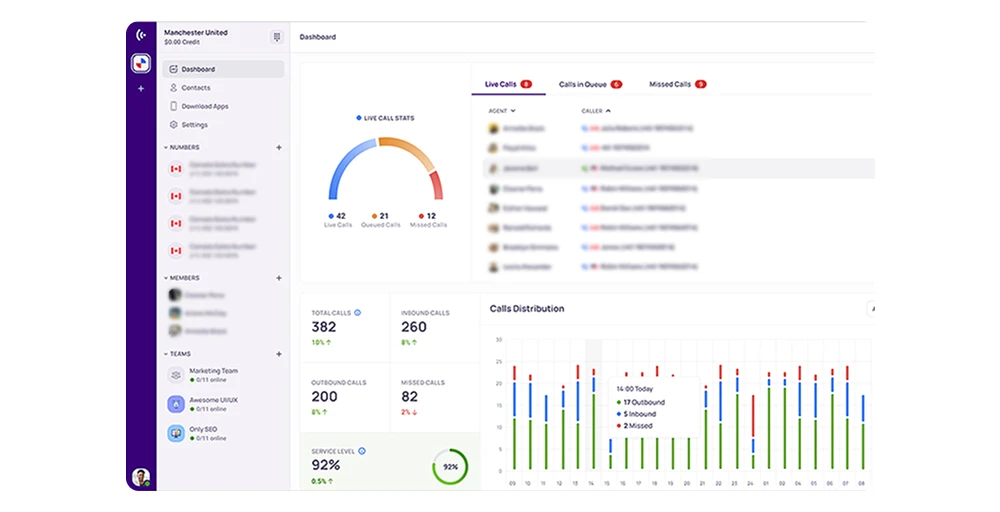
You can merge your legacy analog system and VoIP system across various departments with KrispCall’s advanced VoIP platform, while keeping all call data synced with your CRM. Moreover, the compatibility with VoIP phones, softphones, and PBX systems ensures a smooth transition without disrupting daily operations.
Experience seamless communication and privacy with KrispCall’s business phone system. Get your virtual number today to get started or book a demo to learn more on how it works.
Frequently Asked Questions
Do VoIP gateways support faxing?
Yes, VoIP gateways do support faxing. Most modern gateways offer T.98 fax relay support, the protocol responsible for transmitting fax signals over the internet connection.