

Many businesses still use an outdated wired voice network for their internal business interactions. If you are one of these businesses, then you are limiting yourself with less reliability, scalability, complex setups, and, importantly, high upfront costs.
To overcome these obstacles, you have to make a jump to a more modern alternative: A Hosted PBX. It uses the internet to give your business more flexibility and cost-effectiveness.
In this blog, let us discuss what a hosted PBX is, how it works, and how it meets the current business requirements.
✨ Key Takeaways
- Hosted PBX is a cloud-based phone system where your VoIP service provider hosts the service on their servers instead of using on-site hardware.
- Key features of Hosted PBX phone systems auto-attendant, call routing & forwarding, IVR, voicemail to email/text, CRM integration, call analytics, and reporting.
- To set up a hosted VoIP, analyze the cost, consider built-in features, ensure support is not overlooked, prioritize security, and evaluate ease of use.
What is a Hosted PBX?
A hosted PBX is a cloud-based system that is hosted by a third-party service provider over the internet.
Since it is hosted and maintained by a VOIP service provider, it eliminates the burden of installation and management of hardware at your workplace.
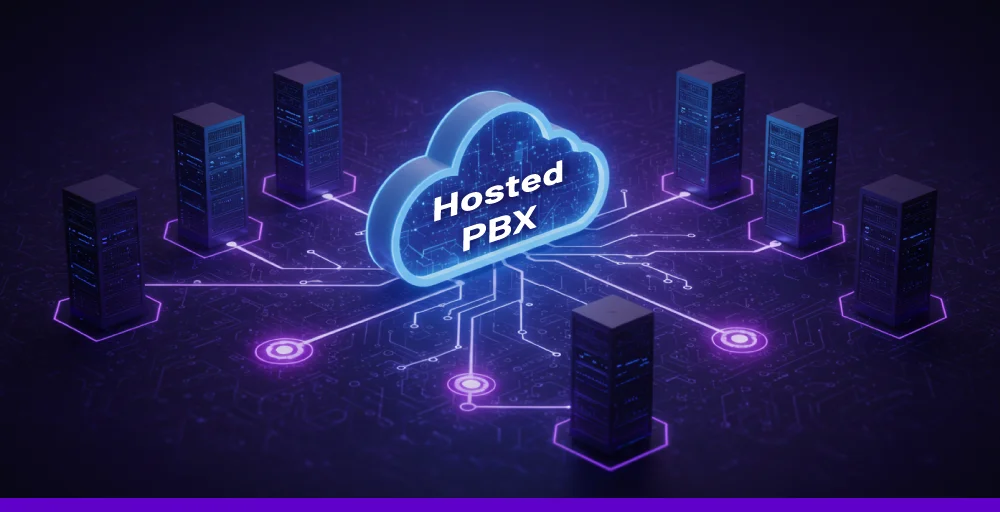
Similarly, Hosted PBX allows all the phone lines, call routing, voicemail, conferencing, and auto-attendant through the cloud without relying on physical hardware.
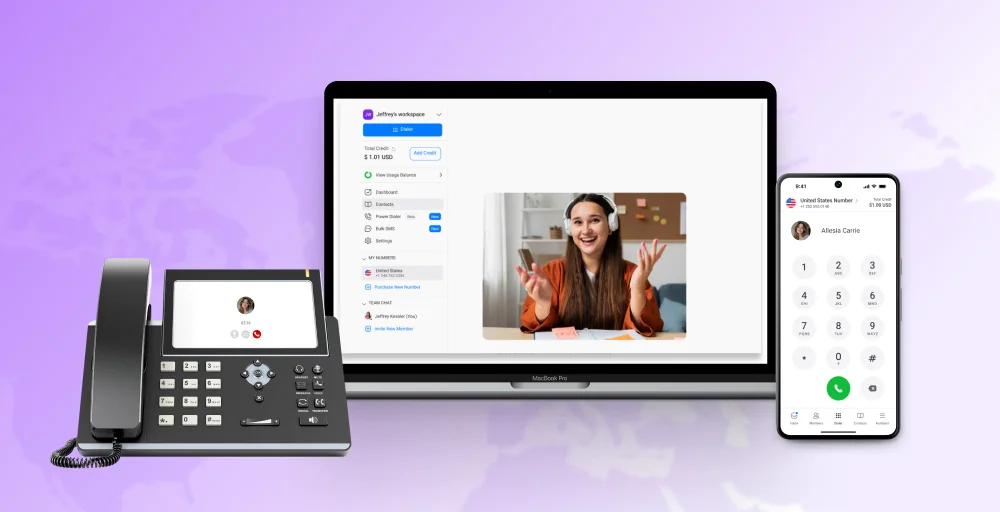
With hosted PBX being internet-based, employees can make and receive business calls from anywhere using their desk phones, softphones, or mobile apps, all while maintaining a professional appearance with their business number.
How Does Hosted PBX Work?
Hosted PBX works on the principle of VoIP and cloud-based infrastructure, which relies on the internet to transmit the voice data. When a call is made, the voice is converted into digital packets and transmitted over the Internet to the recipient.
The cloud PBX then receives the call and triggers the auto-attendant, which gives the caller menu options (e.g., “Press 1 for Sales and press 2 for support”) based on which the call is routed to the appropriate person or department.
If the recipient is unavailable, the caller is requested to leave a voicemail. The message is stored in the cloud and can be accessed from any device anywhere.
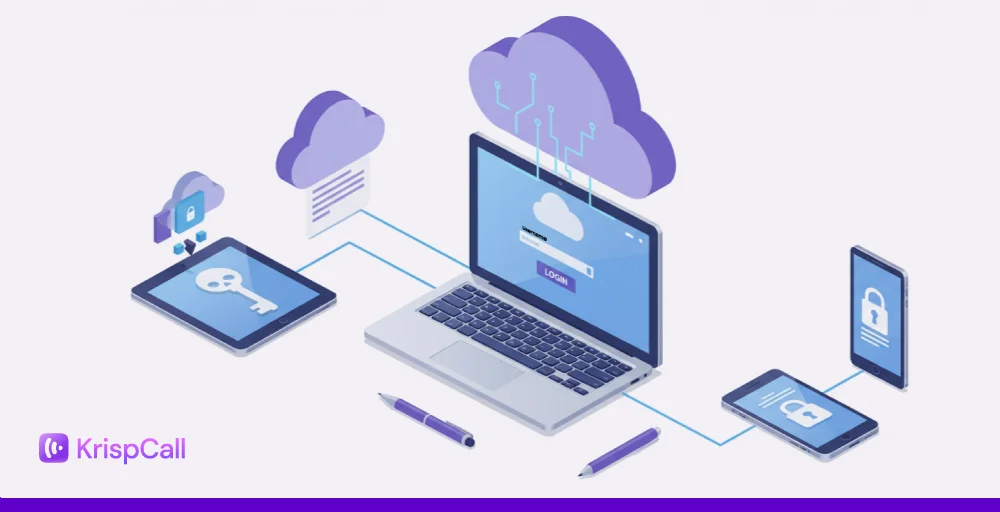
Every aspect of system maintenance, security updates, uptime monitoring, and technical management is handled by the hosted phone system company, so you don’t have to worry about manual updates.
Key Features of Hosted PBX Phone Systems
Hosted PBX systems are aligned with business-friendly features that go far beyond just making and receiving calls. Businesses can adjust call flow settings and direct routing instantly with hosted PBX features from a reliable cloud phone system. Here is what you can expect:
- Auto attendant: It has a virtual receptionist that greets callers and transfers them to the right person or department.
- Call routing & forwarding: Calls are routed to any device, regardless of location. It is ideal for remote or hybrid teams that are not tied to a desk.
- Voicemail to email/text: If agents receive a missed call, they can also maximize voicemail messages sent to your email inbox or phone number, so that you never miss updates.
- Call recording: Agents can record calls into and out of the business for training, quality, or legal compliance purposes.
- Mobile app & softphone access: Users can easily make and receive business inbound calls from their smartphone or computer using an app.
- Audio and video conferencing: Representatives can collaborate with the team or clients using built-in conferencing tools without the need for third-party software.
- IVR (Interactive Voice Response): It has self-service menus so callers can get information or take actions without speaking to a live agent.
- CRM integration: It supports CRM integration tools like Salesforce, HubSpot, or Zoho to streamline workflows and personalize customer interactions.
- Call analytics & reporting: It allows tracking call volume, duration, peak times, and team performance to make smarter staffing and customer service decisions.
- High-level security: Calls are encrypted using protocols like SRTP and TLS to ensure data privacy and compliance.
- Scalability: Businesses can easily add new users or phone lines in minutes without extra wiring.
Benefits of Hosted PBX for Businesses
A hosted PBX system for small businesses offers far more than basic internet-based calling. It is a modern telephony infrastructure that adapts to your business.
1. Lower Operational Costs
One of the most immediate benefits of hosted PBX is the significant cost savings. There’s no need to invest in expensive hardware, on-site servers, or ongoing maintenance.
- Small businesses can launch with minimal capital.
- Mid-size companies reduce IT overhead.
- Large enterprises avoid the sunk costs of legacy systems and telecom specialists.
2. Highly Customizable with Better Control
A hosted legacy PBX system can be easily customized without infrastructure changes.
- Small businesses can tweak call routing and voicemail settings easily without relying on external support.
- Mid-sized companies gain the ability to manage call forwarding, conference lines, and caller IDs instantly, improving workflow efficiency.
- Large enterprises benefit from business communication preferences, reducing reliance on telecom providers for basic changes.
3. Remote Work Support
The best business phone service is always flexible for remote work. Using a cloud-based PBX, employees can make and receive business calls from anywhere via desktop or mobile phone apps, maintaining flawless communication and increased productivity.
- Startups can launch fully remote.
- Retail and healthcare staff can stay connected across branches.
- Enterprises can support global teams under one unified phone system.
4. Secured Calls & Effortless Maintenance
Since Hosted PBX solutions are hosted by the provider, you don’t have to worry about software updates, troubleshooting, and uptime call monitoring.
- Small businesses can sleep at night knowing software updates and troubleshooting are conducted without interruption.
- Mid-sized organizations have an easy-to-use web interface that allows administrators to adjust call routing or add extensions with a single click.
- Large enterprises’ call center data is safeguarded and tracked without the need for in-house technical personnel.
5. Extremely Reliable & Redundancy-optimized
Hosted PBX offers a significant advantage in being extremely reliable, with redundancy built in.
- Small businesses eliminate the risk of physical hardware malfunctions and ensure uptime.
- Mid-sized organizations can rely on connected data centers that provide failover protection, ensuring services remain up.
- Large companies maintain smooth communication continuity even during adverse weather conditions or a catastrophe, with calls being able to be diverted to remote workers or voicemail.
Hosted PBX vs. Traditional PBX
Hosted PBX is a cloud-based system managed off-site by a service provider. Traditional PBX is an on-site system that requires physical installation and maintenance of equipment.
Let’s compare modern hosted PBX systems with traditional PBX systems to help you decide what you need and what is well-suited to your business needs for advanced functionality.
| Hosted PBX | Traditional PBX |
| No upfront hardware costs | High upfront costs for equipment |
| Quick, remote setup via the internet | Complex, on-site installation required |
| The provider handles maintenance | Requires an in-house IT team |
| Easily scalable with a few clicks | Scaling needs physical hardware upgrades |
| Full control from anywhere | Tied to a physical office location |
| Monthly subscription-based pricing | One-time investment + ongoing upkeep |
| Automatic software updates | Manual updates and patches are needed |
| Supports remote and hybrid teams | Limited remote accessibility |
Who Should Use Hosted PBX?
Cloud-hosted PBX is well-suited for all businesses as it is built for any organization that values flexibility, scalability, and cost control in its systems.
Usually, it is ideal for:
1. Small businesses: Small businesses can use a hosted PBX because it reduces costs, provides advanced features, and offers flexibility as compared to traditional telephone lines.
2. Remote & hybrid teams: Remote and hybrid teams can benefit from a work-from-home culture, as everything is cloud-based, so they don’t have to worry about physical locations.
3. Growing enterprises: Growing businesses can focus on scalability, as hosted PBX makes it easy to add more lines quickly when needed.
Top Industries that love hosted PBX service;
- Healthcare: Hosted PBX ensures that patients’ incoming calls are routed securely and efficiently across multiple clinics or departments.
- Retail & E-commerce: It manages high call volumes, support centers, and delivery coordination without missing a beat.
- Tech startups: It provides a modern, agile communication system that scales fast without draining your runway.
- Legal & financial services: You can utilize call recording, voicemail transcription, and secure connections to maintain compliance and professionalism.
Here’s a guide on how to replace your PBX system.
How to Choose a Hosted PBX Provider?
Switching to a modern hosted PBX system is a smart move for many businesses, but choosing the right provider is really important.
With so many options available today, it’s important to focus on what really matters. Here’s what to look for when making your decision.
1. Start By Understanding the Total Cost
When you are setting up your host PBX, the total cost can vary. This cost variation depends on which VoIP phone or VoIP phone system you choose.
So, you must check their monthly pricing. After that, check if it has any hidden charges for extra features and services. A provider with simple and clear pricing helps you avoid unexpected costs later.
2. Consider the Built-In Features
Not all hosted telephony and cloud PBX providers offer the same set of tools. Some offer advanced features such as call routing, voicemail-to-email, auto-attendant, and real-time analytics. Others limit their offerings or lock key features behind higher-priced plans.
So, consider which features you need in your daily workflow and what tools you and your team rely on. Then, make sure the provider covers those essentials without forcing you to upgrade.
3. Don’t Overlook Support
When something goes wrong, your provider must provide fast and reliable support. Therefore, look for providers that offer 24/7 customer service and easy access to real humans.
To find the ideal platform, take time to read customer reviews. They can give you a clear picture of how responsive and helpful the support team really is.
4. Security Should Be Your Top Priority
Since your potential provider will handle sensitive business calls and data, make sure they have strong security measures and practices.
So, look for services that utilize encryption, follow best practices in data protection, and meet industry compliance standards, such as HIPAA or PCI.
5. Consider Ease of Use
Even the most powerful system isn’t helpful if your team struggles to use it. A good hosted PBX platform should be simple to set up, with user-friendly apps and tools that don’t require technical expertise.
Also, check if this provider offers an onboarding and training program or video. A short learning curve means you’ll be up and running in no time.
Conclusion
If someone asks, “What is hosted PBX?” it’s much more than just a phone system. It’s a cloud-based VoIP solution that helps businesses manage calls efficiently and stay connected from anywhere.
Hosted PBX offers flexibility, cost savings, and reliable uptime by routing calls through the cloud. It’s a great fit for remote teams, small businesses, and growing companies.
To get the best value, go with a provider that offers essential VoIP features, SIP trunk support, and fair pricing.
KrispCall delivers all that, tailored to your needs.
Book a free demo to see how a cloud PBX can upgrade your business phone setup.