

Looking for a cost-effective solution for your business communication? Cloud telephony is a modern communication solution that uses the internet to manage phone calls instead of traditional phone systems.
If you doubt whether you should switch from your existing business phone service to cloud telephony, this guide helps you understand its benefits, use cases, how does cloud telephony work, and how to choose your cloud telephony provider.
✨ Key Takeaways
- Cloud telephony is an internet-based phone system that replaces traditional on-premise PBX hardware, allowing businesses to handle calls, messages, and collaboration from any location.
- Cloud phone systems operate through VoIP technology, converting analog voice signals into digital packets and routing them securely through cloud servers managed by a provider.
- Businesses with cloud telephony benefit from lower setup and maintenance costs, faster deployment, flexible scalability, and reliable communication tools with enhanced mobility.
What is cloud telephony solution?
Cloud telephony, also known as cloud calling or a cloud phone system, is a communication service that uses the internet instead of traditional phone lines.
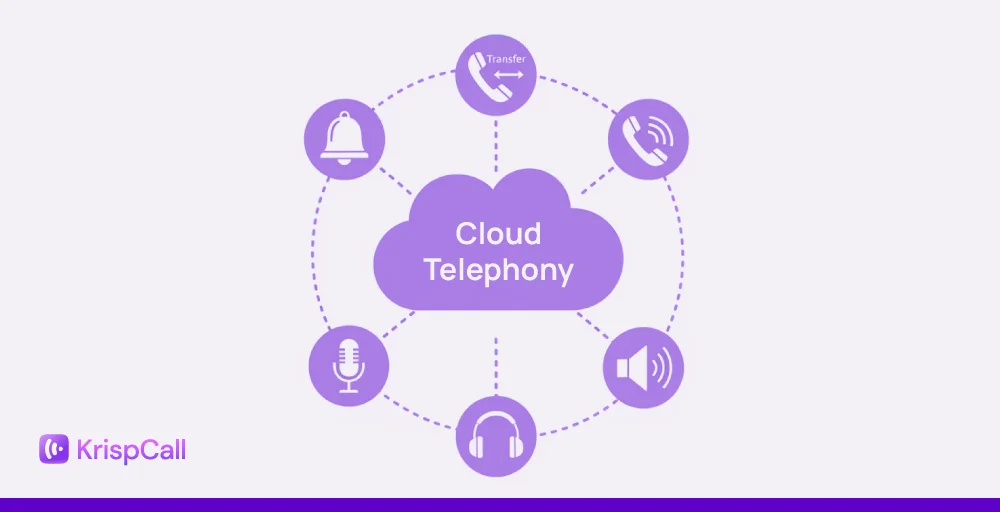
Cloud telephony moves your business phone system from traditional on-premise hardware to the cloud, enabling communication through the internet. For this reason, it is also referred to as cloud calling and a hosted PBX system. Cloud telephony is also a type of unified communications as a service (UCaaS), which centralizes collaboration tools, voice, chat, video, and file sharing into a single platform.
With cloud telephony services, businesses can handle communication with higher efficiency and expand teams effortlessly. At the same time, it saves a hefty amount that businesses spend on infrastructure and hardware.
Cloud telephony examples
Remote Team Communication: Employees from different locations can use the same cloud-based phone system to make calls, check voicemail, and forward calls, improving collaboration.
Virtual call centers: Call centers can use cloud telephony to route calls to agents anywhere, making it easier to manage high call volumes without expensive hardware.
Global expansion with virtual Numbers: Businesses can get virtual phone numbers in different countries, allowing them to appear local without the need for physical offices.
How does cloud-based telephony work?
Cloud telephony works through the VoIP service provider, which is responsible for routing calls through the internet connection. Whenever you dial a number with an IP or softphone app, analog voice signals are turned into digital packets and are transmitted over the provider’s cloud servers.
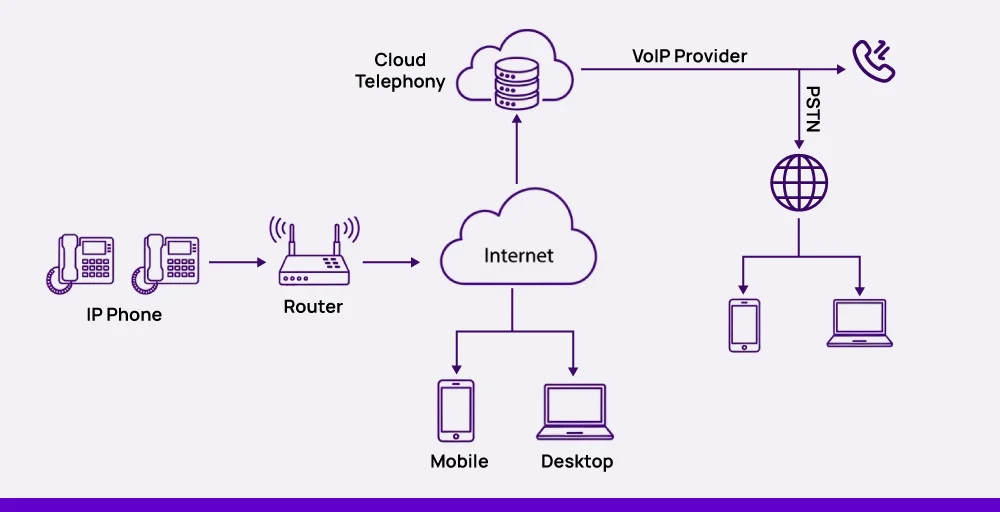
A softswitch on the provider’s server manages and directs calls using predefined settings such as IVR menus or direct extensions. If a call needs to reach a traditional landline or mobile number, the softswitch seamlessly connects it to the Public Switched Telephone Network (PSTN).
That’s how the process of cloud telephony works: connecting your outbound calls to the recipient.
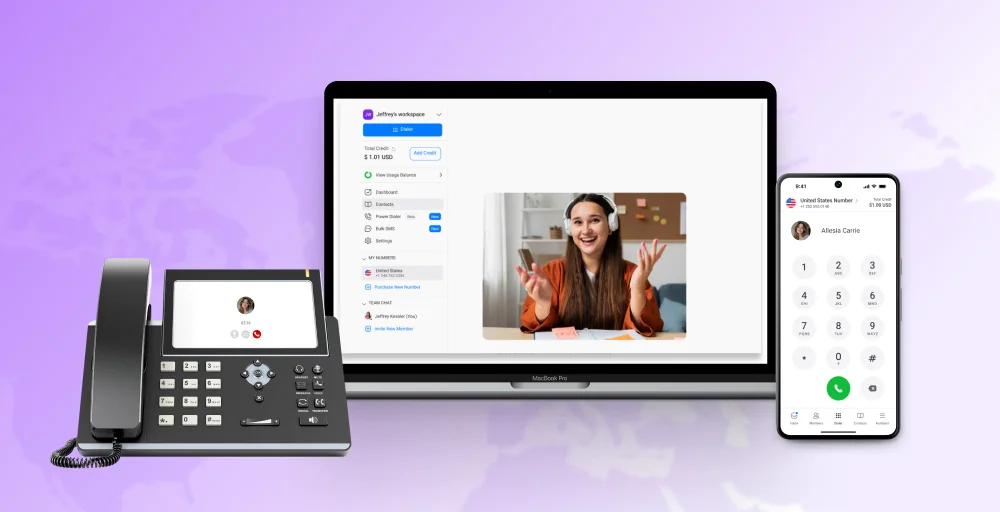
You can use a VoIP desk phone, softphone, or even a computer to make and receive calls. Additionally, managing your cloud PBX is even simpler as the online dashboard covers all phone numbers, creating new users, call recording, analytics, and more.
Top cloud-based telephony solution providers
The cloud telephony market is increasing rapidly, with a global estimate of reaching $59.5 billion in 2034. As of today, there are numerous cloud telephony providers that offer unique features to streamline business communications.
Comparison Table: Best cloud-based telephony solutions
| Platform | Best for | Price | G2 Review rating |
| KrispCall | Global virtual numbers, advanced VoIP features like unified callbox, call monitoring | $15/user/month | 4.5/5 |
| RingCentral | Large businesses that need strong and scalable communication systems | $20/user/month | 4.5/5 |
| Zoom Phone | Small teams that need video and voice calls in one platform, with Zoom integration | $15/user/month | 4.6/5 |
| Dialpad | Enterprises that need AI-powered analytics and automatic call routing | $15/user/month | 4.4/5 |
| Nextiva | Companies needing AI call routing, analytics, and easy scalability. | $15/user/month | 4.5/5 |
| GoTo Connect | Teams needing customizable call handling and scalable communication | Based on quote | 4.4/5 |
| Grasshopper | Small businesses looking for affordable, quick-to-start, mobile-first tools | $14/user/month | 3.9/5 |
| CloudTalk | SMBs and growing teams needing a cloud-based phone system | $19/user/month | 4.4/5 |
| 8×8 | All-in-one customer experience: voice, video, and chat | Based on quote | 4.1/5 |
| Vonage | Small to mid-sized businesses wanting dependable VoIP with automated call handling | Based on quote | 4.2/5 |
Among them, some of the reliable cloud telephony solution providers are:
KrispCall: KrispCall is an AI-powered cloud telephony provider that offers advanced VoIP features, including a Unified Callbox, IVR, call monitoring, global calling, analytics, and instant messaging. It supports numerous CRM and business tool integrations and provides virtual numbers from over 100 countries at an affordable price, making it perfect for small to large businesses.
Nextiva: Nextiva is an all-in-one communication solution that provides cloud telephony services, including video, text, and chat services. While it comes at a slightly higher price point, it’s a strong fit for small to medium-sized businesses, especially those with remote, in-house, or hybrid teams seeking a reliable and unified communication system.
RingCentral: Medium to large businesses can utilize RingCentral’s text, calling, and video conferencing features. It offers an enterprise-grade encrypted VoIP system; however, the cost might not be affordable for small businesses.
Vonage: Voice, SMS, team chat, and video are the valuable communication features of Vonage Business Communications. The price is competitive, which makes Vonage a good choice for small businesses; however, the call routing and queuing features are missing.
Top benefits of cloud-based telephony for businesses
Poor communication service for businesses can result in lost customers and hinder the company’s growth. A poll conducted among 1,400 employees reveals that 86% of employees believe ineffective communication is a primary reason for workplace failures.
That’s why businesses need to keep up with technology and ensure it aligns with rising customer expectations, while maintaining efficient communication within the team.
Here’s how cloud telephony can be beneficial for your business growth.
1. Cost savings
Cloud telephony systems don’t require hardware implementation like traditional private branch exchange (PBX) systems. Instead, it operates online, which significantly reduces operating costs for businesses.
According to the Microsoft report, 82% of surveyed customers reported reduced costs as a result of using cloud technology.
Additionally, you can scale your business without worrying about your budget and still receive other cost benefits such as low monthly subscriptions, a pay-as-you-go model, and no high roaming charges for international calls.
2. Quick implementation
Cloud-based phone systems can be set up without on-site infrastructure, which takes no more than a few days (typically a day).
Even if you’re not tech-friendly, don’t worry. There’s no need for an external technician to come and install the whole infrastructure; instead, your service provider handles everything.
You can get the desired virtual phone numbers and start using advanced features to manage your cloud phone service. All these shorten the lengthy and hassle-filled process of setting up business phone service into some simple, easy steps.
3. Higher mobility & scalability
Whether you’re a new startup or an established organization, cloud telephony systems can be ideal for expanding your business operations. You can add as many agents as needed and handle a large volume of both inbound and outbound calls without requiring hardware upgrades.
Additionally, hosted phone systems are perfect for the increasing remote work culture. Employees can work from anywhere at any time if they have an internet connection. Not limited to basic cloud calling, they can even set up call forwarding, check voicemails, and configure other settings remotely.
All of this is possible just with a mobile and the internet.
4. Reliability & security
With a cloud telephony system, customer calls and data are encrypted, protecting sensitive information. These systems come with built-in redundancy, helping ensure business continuity even during outages.
Reputable providers also focus heavily on VoIP security, offering features like call encryption, intrusion detection, and multi-factor authentication to safeguard communications.
Although reliability varies based on the cloud telephony systems, you’ll be rewarded with high reliability if you choose a reputable cloud telephony provider. Popular names like KrispCall, Nextiva, and RingCentral are examples of reliable cloud telephony services.
5. Powerful calling features
Cloud telephony services come with advanced (Voice over Internet Protocol) VoIP calling features. These features help your business work efficiently and increase productivity, eliminating the need for repetitive tasks and enhancing your customer support.

Some of the top call management features of a cloud telephony solution are:
- Call forwarding: Directs the call with the pre-defined rules and criteria.
- Virtual numbers: Options to choose any local, toll-free, or vanity numbers.
- Customer service automation: To reduce manual work and speed up responses using smart routing, ticketing, and CRM integration.
- Interactive voice response (IVR): A navigation phone menu with pre-recorded messages.
- Auto-attendant: Answers incoming calls automatically and routes based on the caller’s input.
- Call recording: Store recorded calls for evaluation and quality control.
- Contact center: To help your support team manage high volumes and resolve queries quickly.
These powerful calling features are supported by a range of cloud telephony tools, many of which are essential for running an efficient contact center
Cloud Telephony vs. VoIP
Cloud Telephony and VoIP are often used interchangeably, but they differ in their functionality. Take it like this: Every cloud telephony solution utilizes VoIP technology, which is one of the platforms that uses VoIP.
But not all VoIP systems necessarily run in the cloud. VoIP is the center of modern calling systems, whether it’s a cloud-based or an in-house phone system. That means VoIP can also be used with an on-site PBX system.
On the other hand, digital telephony is a phone system that is entirely hosted online, providing flexibility.
Cloud telephony enables users to communicate from anywhere, using Wi-Fi or data from a portable device.
Everything is managed by a VoIP service provider, from call management and user settings to call routing, voicemail, and more.
Here’s a table comparing cloud telephony vs VoIP.
| Feature | Cloud Telephony | VoIP |
| Definition | A phone system hosted in the cloud using VoIP | A technology that delivers voice calls over the Internet |
| Infrastructure | Fully cloud-based, no on-site hardware needed | Can be cloud-based or run on-premises (PBX) |
| Setup and Maintenance | Quick to set up, low maintenance | On-prem systems require hardware setup and upkeep |
| Scalability | Highly scalable with a few clicks | Depends on the setup; on-premises scaling can be costly |
| Mobility and Remote Access | Accessible from any internet-connected device | Varies—cloud VoIP allows it; on-prem VoIP may not |
| Cost | Lower upfront costs; pay-as-you-go models | On-prem VoIP has a higher initial investment |
| Best for | Remote teams, growing businesses, and multi-site offices | Stable businesses with internal IT and fixed operations |
Cloud telephony is ideal for businesses that prioritize remote flexibility, cost-efficiency, and modern features without the burden of maintaining hardware. VoIP, while still essential, is just the technology behind the scenes; how you choose to deploy it (on-site or in the cloud) will shape your communication experience.
Top use cases of cloud telephony solution services
Cloud telephony provides scalable, cost-effective communication tools that boost efficiency and customer engagement. Below are four key use cases of cloud telephony.
1. Sales teams
The sales team can utilize cloud telephony platforms to improve sales with features including click-to-call, auto-dialing, and CRM integration for closing more deals.
For example, a real estate agency can utilize the click-to-call feature with CRM integration to connect agents, potentially improving response times and closing 20% more deals.
2. Healthcare services
Cloud telephony is widely used in healthcare due to its secure call routing and ability to protect patient information. It ensures high deliverability and compliance with privacy regulations.
For example, a local clinic can use a cloud-based phone system to send automated reminders or simply route patient calls directly to the specialists. This can reduce no-shows by a significant percentage and improve patient engagement..
3. Customer support
In e-commerce, cloud telephony enhances customer service by using IVR menus and call analytics to intelligently route calls and deliver customer context to agents. These features are the backbone of a modern contact center solution, improving response time and customer satisfaction.
With 81% of customers favoring self-service options, features like automated call routing and customer service automation significantly reduce wait times, and free up agents for more complex issues.
For example, an e-commerce company can use IVR for directing customer queries to the right department and reducing wait times.
4. Remote workforce
Your teams can stay connected remotely with reliable cloud communication tools such as cloud calling, instant messaging, and video meetings.
It helps teams collaborate easily and provides flexibility for remote workers.
What are the risks of cloud telephony systems?
Here are some of the drawbacks of cloud calling that you should be aware of before using it.
- Dependency on the internet: Cloud telephony is entirely based on the internet connection, meaning your internet speed and coverage are crucial. With an unstable connection, you experience dropped calls, resulting in communication disruptions.
- Service downtime and outages: VoIP providers might experience server outages and maintenance issues at some points. With this, your business communication can be paused, which might affect customer service.
- Compatibility issues: Though most of the modern devices support VoIP telephony services, there are still traditional PBX systems that might not fully integrate with cloud calling solutions. So, it’s important to check the compatibility with your existing devices.
How to choose the right cloud telephony service provider?
If you have decided to switch to a telephony solution, the providers mentioned can be a great fit. Even if you want to evaluate your options, consider the following points.
Does it fulfill your needs?
First, evaluate the business position you’re in: what you expect from a cloud telephony solution. The right VoIP provider ultimately depends on your business size, aims, and budget. If you’re just a startup with a team of 10-20 people, you can choose a cloud telephony platform that is affordable yet provides basic VoIP features.
Some of the options are KrispCall, Vonage, and Google Voice. However, if you are a medium-sized business looking to scale to a larger scale, opting for Nextiva or RingCentral can be a great fit.
Is it reliable?
Reliability is what differentiates the VoIP cloud telephony providers from each other. You don’t want to invest in a business phone system just to receive constant network disruptions, server outages, and maintenance issues.
It’s essential to discuss the provider’s uptime before subscribing to a plan. A 99.9% or higher uptime guarantee, along with 24/7 customer support, must be provided. Additionally, ensure that they have redundant systems and data backups to prevent any loss due to service interruptions.
Can you check the reliability? Yes. Existing users put their honest reviews and feedback on sites like G2 and Trustpilot. You can start observing reviews from the people who rated the product the least and understand how worse the service can go.
Are the features worth paying for?
The deciding factor in whether to choose business phone service depends on its features. You can know it by answering these questions. Do you want multiple numbers? What is your coverage target? Are you looking to scale your business? What features are must-haves for your business?
You can directly place these questions to the service provider support teams. Besides that, go through the offering of product features. At a minimum, the cloud solution should provide you with features including VoIP calling, business texting, IVR, virtual numbers, and CRM integrations.
Above that, it is all about the quantity you want. For example, if sending cold business texts is part of your plan, you need the bulk SMS feature from your service provider. Additionally, research whether you’re paying the right price for the same features.
Some providers might charge you more for the same feature that is available at comparatively lower prices from other cloud telephony platforms.
Does the provider align with security standards?
Another step is to ensure that your cloud solutions comply with legal guidelines and operate within industry standards. Here are some trust marks to look for:
- HIPAA compliance: Secure handling of protected health information within calls.
- ISO/IEC 27017: International standard that provides guidance on information security controls for cloud services.
- SOC 2 (Type II) compliance: Verifies provider’s availability to safeguard cloud telephony data.
- GDPR: Mandatory EU regulation for data privacy.
- ISO/IEC 20071: Global standard for risk management and security controls.
- PCI compliance: Handling credit card payments securely within cloud services.
Why KrispCall for cloud telephony solutions?
Switching to a cloud system is an easier and quicker process. You’ll eliminate expensive hardware and offer flexible telephony features. To maximize these benefits, you’ll need the right provider that is reliable, feature-rich, and at the same time affordable.
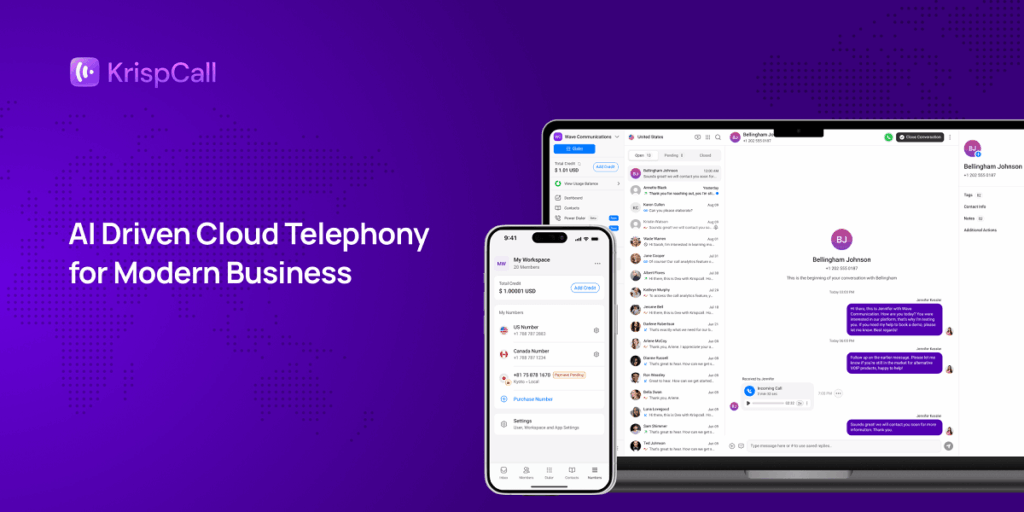
And, KrispCall meets all your needs. KrispCall stands out as the top choice for a cloud telephony solution with its feature-rich and affordable offerings.
KrispCall has been serving thousands of businesses and has constantly become their favourite. Whether you’re a startup or a medium-sized business, KrispCall can fulfill your telephony needs. Best thing? You can scale your business whenever you want, as you can get as many numbers as you want from KrispCall.