

When it comes to picking a business communication system, you’ll often hear about PBX vs VoIP. Choosing between the two depends on several key factors, such as your business size, budget, need for flexibility, and how well the system supports remote or hybrid teams.
PBX phone systems are the more traditional option, still favored by many large enterprises for their consistent call quality and full control over in-house infrastructure.
VoIP, on the other hand, is a modern solution that delivers greater flexibility, lower upfront costs, and a wide range of advanced features. In fact, over 70% of businesses have shifted to VoIP solutions due to cost savings and flexibility.
In this PBX vs VoIP comparison, we’ll explain both of these systems in detail, discuss their key differences, and compare their benefits and limitations to help you decide the best system that aligns with your needs and budget.
✨ Key Takeaways
- PBXs are legacy phone systems that use physical phone lines for communication, whereas VoIP is a modern communication technology that relies on your internet connection.
- Traditional PBX systems are more reliable as they are hardwired. However, they’re expensive, rigid, offer limited features, and are difficult to scale.
- Modern VoIP systems are flexible, cost-effective, feature-rich, and can be scaled easily. But being an internet-reliant service, its reliability depends on your internet.
What is PBX?
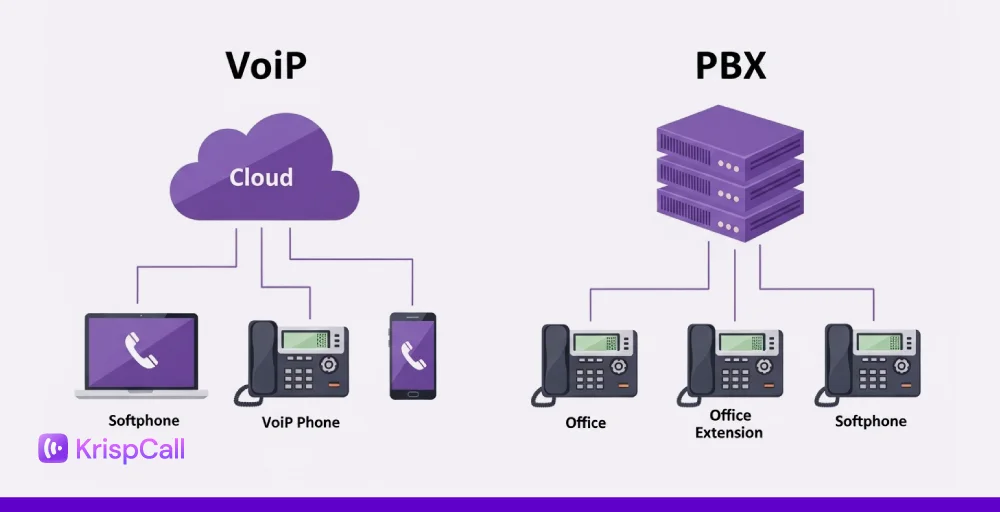
A PBX (Private Branch Exchange) is a traditional phone system that connects and routes calls between internal extensions and external phone lines.
It uses dedicated hardware installed on-site to handle all phone communications.
As a legacy system, PBX relies on physical wiring and PRI (Primary Rate Interface). It interconnects your internal business phones via extension numbers and links to the PSTN for external calling.
This setup lets you make and receive both internal and external calls seamlessly.
Many businesses prefer a PBX system as it offers basic key features such as:
- Call forwarding and transferring
- Extension phone numbers
- Voicemail system
- Auto-Attendant
- Call queues and conferencing
- Call recording, monitoring, and reporting
What is VoIP?
VoIP (Voice over Internet Protocol) is a modern communication technology that allows businesses to make phone calls using their broadband internet rather than physical phone lines.
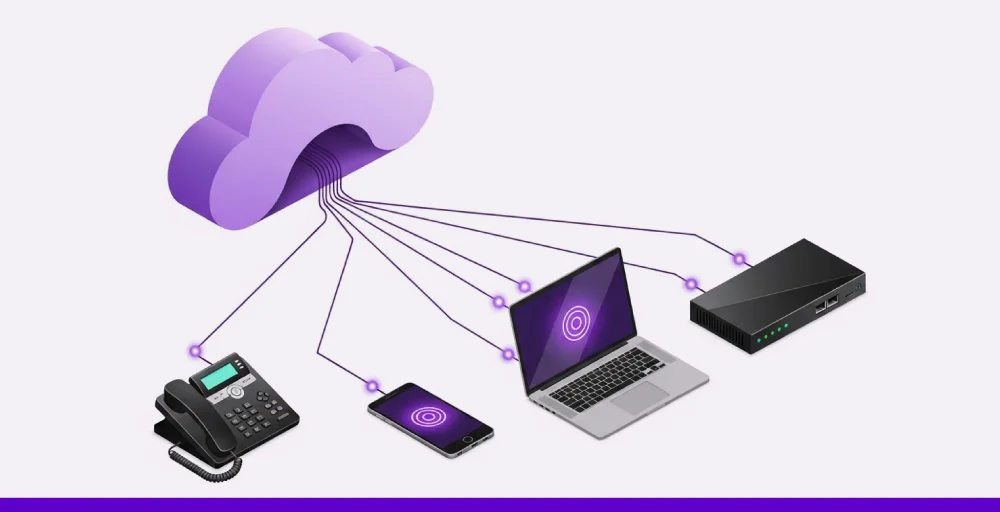
It works a bit differently from PBX. VoIP converts your analog voice signals into small digital data packets. The system sends these packets to the recipient over the internet, and the recipient converts them back into audio in real time.
This flexibility allows users to make high-quality voice calls from any device connected to the internet.
There are mainly two types of VoIP systems. i.e., hosted VoIP and on-premise IP-PBX.
- Hosted VoIP: Cloud-based system managed remotely by a VoIP provider.
- On-premise VoIP (IP PBX): A business VoIP PBX that incorporates VoIP tech to make phone calls over the internet.
Modern businesses are shifting towards VoIP communication systems as they have more core features compared to traditional systems, such as:
- Voice and video conferencing.
- Messaging feature with online presence status.
- SIP trunking
- Detailed call analytics and reporting tools.
- CRM and other third-party app integrations.
- Mobile and desktop app support.
- Phone Tree.
VoIP vs PBX: A quick comparison
Here’s a quick side-by-side comparison of PBX vs VoIP to help you understand their key differences at a glance.
| Features | PBX (Private Branch Exchange) | VoIP (Voice over Internet Protocol) |
| Call transmission | Traditional PSTN phone lines | Internet-based connection |
| Configuration | On-premise hardware | Cloud-based or on-premise IP-PBX options |
| Initial cost | Expensive (for more hardware and maintenance) | Cheaper (requires less equipment) |
| Monthly price | Can be unpredictable and costly | Predictable subscription-based pricing |
| Scalability | Limited by physical hardware and wiring | Highly scalable, as users can be added or removed digitally. |
| Feature set | Basic call handling and management features | Includes advanced features like video calls, mobile apps, CRM integrations, and analytics |
| Reliability and call quality | Very reliable due to dedicated physical lines | Dependent on the internet connection |
| Security | Physical connections, fewer chances for cyber attacks | Digital service, encrypted but prone to internet attacks. |
| Mobility and accessibility | Restricted to on-site phones and locations | Accessible from any location with any device with a stable internet connection |
PBX vs VoIP: A detailed comparison of key differences
1. Technology and infrastructure
PBX is a legacy phone system that relies on physical hardware installed at your business location. It uses copper telephone wires to connect internal phones, allowing direct communication within the organization.
PBX systems are also linked with the Public Switched Telephone Network (PSTN) line for making and receiving external calls.
That being said, setting up a PBX system involves a more complex setup and higher upfront costs. You need to install hardware on-site and rely on expert technicians for professional configuration.
VoIP systems work by transmitting voice calls over your internet connection rather than using traditional telephone lines. The lack of physical wiring makes VoIP faster to deploy and easier to manage.
VoIP setup is generally simple, no matter the type. With cloud-based systems, the provider manages and maintains everything.
If you already use a PBX, you can integrate VoIP to upgrade it into a hybrid IP-PBX. This lets you keep your existing hardware while also getting the benefits of modern internet-based communication features.
2. Pricing structure
PBX systems are often more expensive as they have a higher upfront investment involving physical hardware, installation charges, etc. A typical PBX system set up can cost anywhere from $3000 to $11000.
The running and timely maintenance costs of these systems depend on factors like hardware repairs, software updates, system monitoring, and technician support.
VoIP uses a subscription-based pricing model that is generally more affordable than PBX systems. They typically require no additional hardware or maintenance fees, as everything from system upgrades to upkeep is handled remotely by the VoIP provider.
In terms of pricing, initial setup for a VoIP system can range from $0 to $500, depending on whether you need equipment like headsets or IP phones. The monthly running subscription fees range from $15 to $40 per user, based on the features offered by the VoIP providers.
3. Features
PBX systems offer the core essential calling features such as call forwarding, voicemail, IVR, and extension dialing. You can add more functionality, but doing so can lead to higher costs and added complexity.
VoIP, being an internet-enabled service, offers advanced features such as high-definition audio calling, video conferencing, voicemail-to-email, call transcription, IVR, CRM integrations, etc.
Many reputable VoIP phone service providers incorporate AI features to further enhance communication efficiency.
However, the availability and performance of these features depend largely on the quality and stability of your internet connection.
4. Scalability and flexibility
PBX systems are less flexible and scalable due to their reliance on physical wiring and on-premise hardware. To add new phone lines, you need to install additional equipment and wiring, which increases both setup time and costs.
VoIP systems provide greater flexibility and scalability by using the Internet instead of physical lines. You can make and receive calls from anywhere on any device with a stable connection.
As your team grows or changes, you can easily adjust the number of users without needing physical upgrades or downtimes.
5. Reliability and security
PBX systems are known for strong reliability and security since they use physical lines and operate independently of the internet. That being said, PBX systems often have a single point of failure. If the central hardware malfunctions, your entire business phone system can go down, leading to extended downtime.
VoIP systems also deliver reliable performance, but they depend heavily on internet stability. Disruption in bandwidth or connectivity can directly impact call clarity or availability.
While VoIP systems are inherently more exposed to cyberattacks due to their internet dependency, businesses that implement strong security protocols, call encryption, and geo-redundant servers can reduce these risks.
In fact, according to Salesforce, 94% of companies experienced improved communication security after migrating to secure cloud-based VoIP or IP PBX solutions.
PBX and VoIP: The pros and cons
Both PBX and VoIP have their own strengths and weaknesses that influence how your business communicates and grows.
Here’s a quick comparison of their key pros and cons to help you make a well-informed decision.
PBX pros
- Delivers consistent, high-quality calls without relying on the internet.
- Physical isolation (physical wiring) lowers the risk of cyberattacks.
- Offers more control over the phone system and its infrastructure.
PBX cons
- Has higher upfront investment and maintenance costs.
- Limited flexibility for remote or hybrid teams.
- Scaling is complex and involves physical hardware and IT technicians.
- Has a single point of failure that can increase the downtime.
VoIP pros
- Offers an affordable setup with predictable monthly billing.
- Accessible from anywhere via devices like desktops, mobiles, and web apps.
- Scales easily without additional hardware changes.
- Offers more advanced call management features like call analytics, voicemail-to-email, and CRM integration.
VoIP cons
- Call quality depends on internet speed and bandwidth stability.
- May require network optimization (QoS) during times of high usage.
- Vulnerable to cyberattacks if proper security measures are not implemented.
PBX vs. VoIP: Which phone system is best for your business?
Despite PBX and VoIP being two different technologies, they serve the same primary purpose: business communication. They operate in distinct ways, so choosing the right business phone system is very important. It can influence operational cost and communication efficiency.
PBX systems are an older, more established technology known for their reliability and essential calling features.
While they require a higher upfront investment and ongoing maintenance, they give businesses greater control over their communication infrastructure. This makes PBX a practical choice for large enterprises with existing infrastructure and dedicated IT support teams.
VoIP systems, in contrast, are a modern, internet-based communication solution designed for flexibility, scalability, and cost-efficiency. It provides advanced features like cross-platform compatibility, call analytics, and integrations with other business tools.
With low upfront costs and easy scalability, VoIP is ideal for startups, remote teams, and growing businesses seeking a modern phone system.
Ultimately, the best choice depends on your business size, budget, IT resources/infrastructure, and communication needs.