

Have you experienced how some VoIP calls sound clear, while others are full of distortion?
That inconsistency may often happen due to VoIP codecs.
If the right codecs are not chosen, it can directly affect call quality, bandwidth usage, and latency. But how to decide which one is the correct choice, and what other components should be considered?
Don’t worry! In this blog, we’ll break down what codecs in VoIP are, what their components are, how codecs work, why they matter, and how to pick the best one for your needs.
✨ Key Takeaways
- VoIP codecs are the technology that compress and transmit signals in VoIP (Voice over Internet Protocol) calls.
- G.722 is preferred for high audio quality and bandwidth, G.729 for bandwidth efficiency, and G.711 for good voice quality with ample bandwidth.
- Choosing the right codec depends on factors like desired audio quality, bandwidth availability, network conditions, and compatibility with existing infrastructure.
What are VoIP codecs?
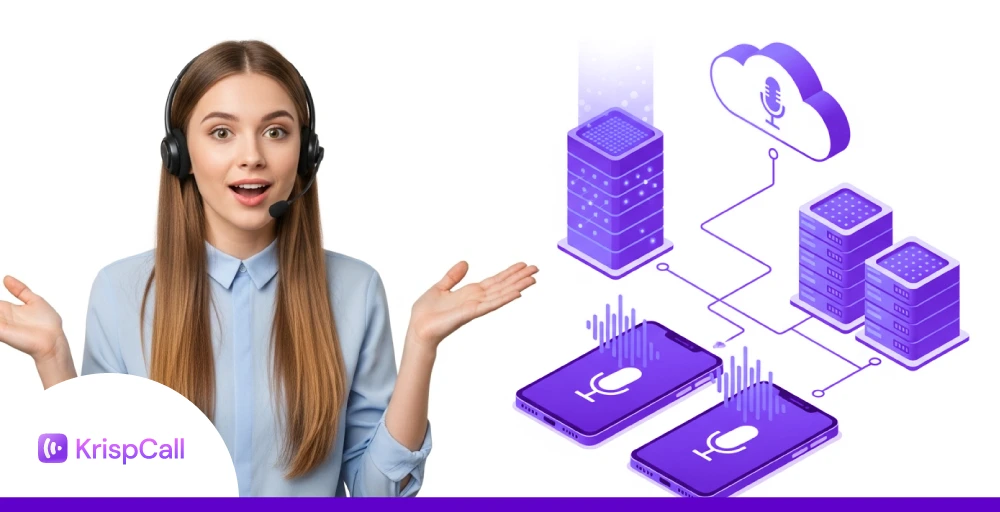
VoIP codecs are the technology that compresses and decompresses voice data to enable internet-based phone calls. These tools help to convert your voice, which is in the form of an analog signal, to digital signals (in the form of packets) to make the transmission smooth. It then decodes the packets and converts them back into their original form.
Essentially, a codec is the engine behind your voice calls. It makes sure the voice travels efficiently over the internet. The choice of codec impacts your call quality and the amount of data used, but it all happens behind the scenes to maintain a smooth calling experience.
Components of VoIP codecs
VoIP codecs are used to determine the VoIP quality of service (QOS) and efficiency of calls over the Internet.
A VoIP codec is an important component of VoIP basics and consists of various components. All these components work together to manage voice compression and transmission, which directly influence call quality and bandwidth efficiency.
Here are some of the significant components of VoIP codecs:
1. Sampling rate
The first component is sampling rate, which shows users how many times the audio signal is captured per second in kilohertz (kHz).
This means that if you want clear audio with defined sound details, then the sampling rate needs to be higher. However, one drawback is that it requires more bandwidth. For this reason, most VoIP codecs use 8kHz for narrowband and 16kHz for wideband audio.
2. Bit depth
Bit depth is the representation of the number of bits in each audio sample. When it is increased, it gives a more accurate sound with better audio quality.
For example, a 16-bit depth offers greater clarity and range compared to an 8-bit depth. But higher bit depth uses more data, which can impact bandwidth.
3. Compression algorithm
The compression algorithm plays a key role in reducing the data needed to send voice over a network.
However, VoIP codecs use different compression algorithms to meet various needs. Some are used to enhance audio quality, while others are employed to optimize bandwidth utilization.
For instance, G.711 transmits uncompressed audio to maintain high-quality audio but consumes more bandwidth. In contrast, G.729 employs stronger compression to save bandwidth but loses audio quality.
4. Packet size
This component of the VoIP codec measures how much audio data is grouped together for transmission. Smaller packet size reduces latency but demands more processing power.
On the other hand, larger packet sizes tend to increase delay while easing processing requirements. Due to this, selecting the right packet size is crucial to balancing audio quality with network performance.
5. Error correction & concealment
VoIP codecs use error correction and concealment techniques to maintain clear audio during packet loss or network disruptions. These methods either fix errors or mask missing data by predicting sounds or repeating previous audio.
As a result, calls remain smooth even when network conditions are less than ideal. These components significantly impact overall call quality, and adjusting their settings can help enhance performance.
How does VoIP codecs work?
VoIP codecs work by converting the analog signal (voice data) into a digital signal (packets) over the VoIP platform. It compresses the data to ensure a smooth transfer and overcome VoIP problems like internet issues.
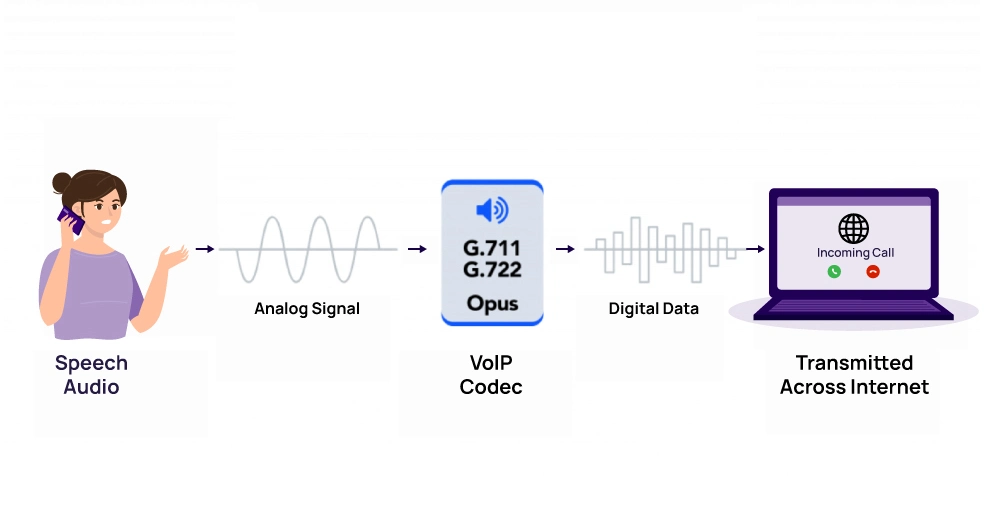
Let’s discuss how VoIP codecs actually work in brief for a better understanding.
1. Analog signal to Digital signal
At first, when a call is initiated, the user’s voice, which is an analog signal, is captured by a microphone. The voice codecs then convert this analog signal into a digital format.
2. Encoding (Compression)
Now, the digital VoIP audio is compressed using various algorithms. To optimize this, the codec compresses these digital data packets and reduces their size to transmit faster over the internet.
Different voice codecs use different compression techniques, which in turn impact factors like audio quality and bandwidth usage.
3. Packetization
The compressed audio is now divided into small packets. Each of these packets has necessary information like sender and receiver address for the smooth transfer.
4. Transmission
The compressed digital data packets are sent across the Internet through a VoIP phone system network.
5. Decoding (Decompression)
At the receiving end, the codec receives the compressed data packets. It then decompresses the data to restore it to its original digital audio form.
6. Digital signal to analog signal
Finally, the codec converts the digital signal back into an analog audio signal, which is then played through the speaker. This allows the recipient to hear the caller’s voice.
Common types of VoIP codecs
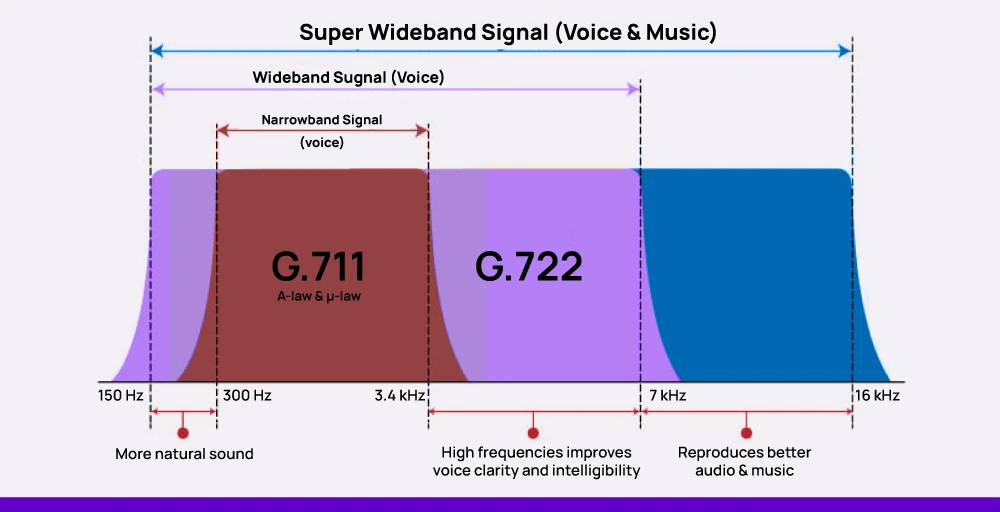
Commonly, the VoIP codecs are of 2 types: Narrowband codecs and Wideband codecs. The primary difference between these VoIP codecs lies in their voice quality, which depends on the extent of the audio frequency range they cover.
1. Narrowband codecs
Narrowband codecs are optimized for lower bandwidth consumption. Since they prioritize the minimal use of bandwidth, it is suitable for situations with limited bandwidth or high call volume.
It typically covers the frequency range of 300 Hz to 3.4 kHz.
Example: G.711 (A-law and μ-law) and G.729
Advantage: It provides efficient bandwidth utilization and is suitable for basic voice communication, making it compatible with older systems.
Disadvantage: It lacks clarity and richness, which impacts call quality compared to wideband codecs.
2. Wideband codecs
Wideband codecs offer high audio quality by supporting a broader range of frequencies. Its primary focus is to provide improved audio quality by capturing a wider range of frequencies, resulting in a natural and clear voice during the call.
It typically covers the frequency range of 50 Hz to 7 kHz.
Examples: G.722 and Opus.
Advantage: It provides enhanced voice clarity, better articulation, and improved call experience that conveys more nuances of speech analysis.
Disadvantage: It requires more bandwidth as compared to narrowband codecs.
Here is a table for quick comparison of different types of cloud VoIP phone system codecs based on their types, sample rate, bandwidth, frequency, license, and best uses.
| Codec | Sample Rate | Bandwidth (kbps) | Frequency (Audio Range) | License | Best For |
| G.711 | 8 kHz | 64 | 300 Hz-3.4 kHz | Free (ITU-T) | Standard telephony, PSTN integration |
| G.722 | 16 kHz | 48–64 | 50 Hz-7 kHz | Free (ITU-T) | Wideband VoIP, HD voice |
| G.729 | 8 kHz | 8 | 300 Hz-3.4 kHz | Royalty-free (since 2017) | Low-bandwidth VoIP, Legacy systems |
| G.726 | 8 kHz | 16, 24, 32, 40 | 300 Hz-3.4 kHz | Free (ITU-T) | Legacy VoIP, Cloud-hosted PBX systems |
| iLBC | 8 or 16 kHz | 13.33 or 15.2 | 300 Hz-3.8 kHz | Free (BSD-like license) | Packet-loss-tolerant VoIP |
| Opus | 8–48 kHz | 6–510 | 50 Hz-20 kHz | Royalty-free (IETF RFC 6716) | VoIP, conferencing, Music, Gaming |
| AMR-NB | 8 kHz | 4.75–12.2 | 300 Hz-3.4 kHz | Patented | GSM voice, 2G/3G mobile telephony |
| AMR-WB | 16 kHz | 6.6–23.85 | 50 Hz-7 kHz | Patented | HD voice, VoLTE, Mobile networks |
| Speex | 8–32 kHz | 2.15-4 | 50 Hz-16 kHz | Open source (Xiph.org) | Open-source VoIP phone system |
How does codecs enhance call quality?
Codecs enhance the call quality by maintaining the stable transmission of the packets. As soon as the analog voice signal is received, it is compressed into the digital signal, and then it is transferred over the internet in small packets. This process happens in real-time and ensures stable communication.
Since it has small packets, it maintains the integrity of each packet and prevents the audio quality.
For example, G.711 provides high voice clarity but uses more bandwidth, while G.729 works well on low-speed networks. Options like Opus automatically adjust to deliver the best sound quality, and wideband codecs like G.722 capture a broader range of your voice.
The best codecs help you avoid common VoIP problems like voice dropouts and handle packet loss by removing network jitter and error concealment.
How to choose the right codec for VoIP?
Choosing the right codec for VoIP can be a little frustrating, but with the best service provider by your side, you can make the right choice that suits your business needs.
Let’s discuss some of the major factors while choosing the best VoIP codec:
1. Bandwidth availability
Cloud VoIP supports multiple simultaneous calls at a time. So, in order to keep up with all the calls while maintaining the call quality, you should look for a stable internet connection with high quality. For this, codecs like G.711 are recommended for high-quality audio and high bandwidth. Similarly, if you have slow or less stable internet, you can go for G.729 or Opus.
2. Voice quality requirements
In order to maintain a clear voice, choose the codecs that offer reasonable voice at your budget. If you are looking for high definition voice quality, go for wideband codecs like G.722 or Opus. At the same time, if you can use standard audio quality, consider narrowband codecs like G.711 or G.729.
3. Latency and Jitter Tolerance
If you want to handle real-time conversations and applications where delay is critical, choose codecs that effectively handle network inconsistencies. For example, G.711 and G.722 are generally preferred for low latency.
4. Compatibility
Ensure all the devices and software of your organization support your chosen codec. Make sure your VoIP provider, VoIP phones, and other equipment are compatible with the selected codec.
5. Licensing costs
Some codecs are available at no cost, while others require a license. And with licensing comes the licensing fees. Before choosing one for yourself, always check whether it requires a license for use.
6. Pricing
Selecting the right codec can affect your overall VoIP cost. So, consider the codec in relation to bandwidth and potential licensing fees. If a codec requires advanced infrastructure or increases system complexity, it might impact your budget in the long run.
Always go for the codec that is budget-friendly for your organization, as it scales.
7. Compression rate
Compression reduces the amount of data that needs to travel over your network. A good codec strikes the right balance between compressing audio data and preserving voice clarity. High compression codecs save bandwidth but may sacrifice sound detail. Low compression codecs deliver better audio but consume more data.
👉 Hence, it is necessary to understand these factors carefully and the trade-off between them. In general, smaller businesses can use free codecs with decent call quality and bandwidth, and large-scale enterprises can focus on providing quality as per their budgets.