

Effective communication is crucial for modern business communication solutions. Whether you’re a small startup or a large enterprise, the type of phone system you choose can directly impact your efficiency, customer experience, and business growth.
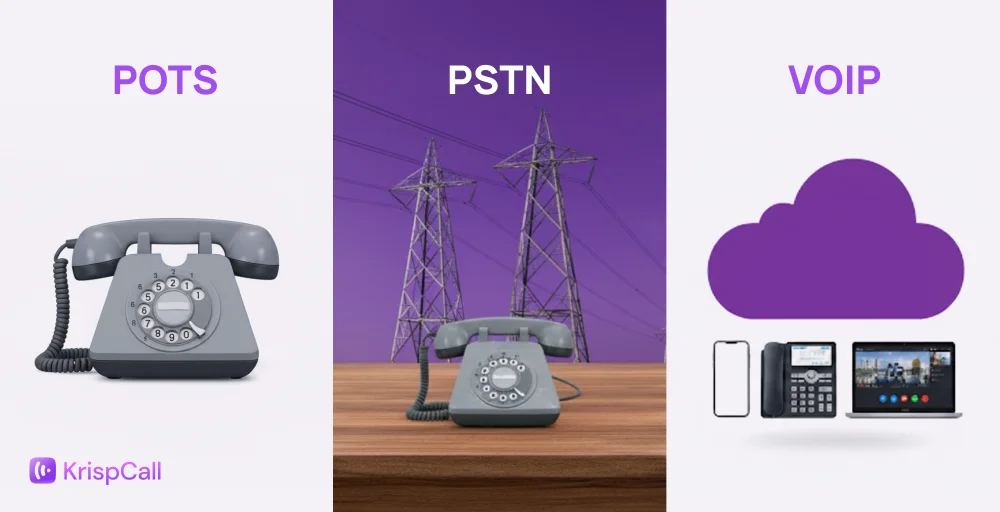
Three main types of business phone systems dominate the landscape: POTS (Plain Old Telephone Service), PSTN (Public Switched Telephone Network), and VoIP (Voice over Internet Protocol). While they all serve the same basic purpose, enabling voice communication, the technology behind each is very different.
Now, let’s explore and understand the distinctions among these three phone systems.
✨ Key Takeaways
- In POTS, PSTN, and VoIP, the POTS and PSTN rely on circuit-switched networks, while VoIP uses digital data packets over the internet, offering more flexibility and lower costs.
- VoIP provides noticeably better call quality than analog POTS and traditional PSTN, thanks to HD voice technology and digital signal processing.
- Switching to VoIP not only reduces maintenance and call costs but also enhances reliability, call quality, and remote collaboration capabilities.
POTS vs PSTN vs VoIP: What each term means
The terms POTS, PSTN, and VoIP represent the evolution of voice communication technology. Let’s dive in to get to know each of them:
What is POTS?
POTS stands for Plain Old Telephone Service, also known as Post Office Telephone Service, which is a traditional analog voice transmission service that operates via PSTN technology. In POTS lines, analog voice transmission occurs over a pair of twisted copper wires.
POTS utilizes a dedicated circuit for each call, ensuring the line remains fully reserved for the duration of the conversation. Despite its age, POTS is known for its high reliability, as the phone company often powers the lines and can continue to function during a local power outage.
What is PSTN?
The short form of Public Switched Telephone Network is PSTN. It is a public telephone network that transmits your voice data in analog format, allowing you to reach any other user on the network with their phone number. The PSTN initiates phone calls via copper wires, fiber-optic cables, circuit switches, and signaling.
The PSTN is the global network infrastructure that interconnects all fixed-line, mobile, and digital telephone systems. While initially an entirely analog system, the PSTN has evolved over the decades to incorporate digital technology, particularly in its core backbone and long-distance trunks.
How PSTN work?
The Public Switched Telephone Network (PSTN) serves as a bridge between traditional telephone lines and modern internet-based phone systems.
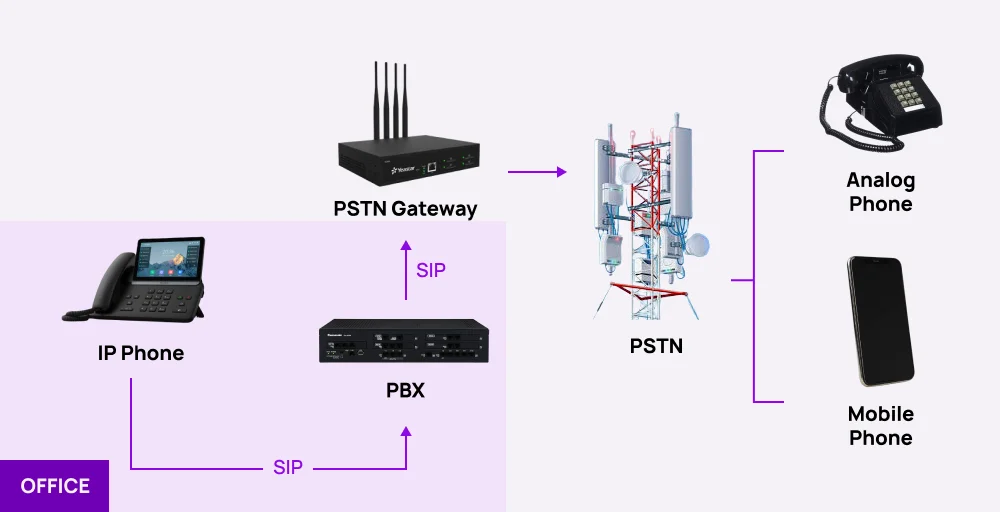
Here’s how PSTN works:
- IP Phone to PBX: An IP phone in an office connects to a PBX (Private Branch Exchange) using the SIP (Session Initiation Protocol) to initiate a call.
- PBX to PSTN Gateway: The PBX routes the call to a PSTN Gateway, which converts the digital data from the IP phone into a format that can be transmitted over the traditional telephone network.
- PSTN Transmission: Now, the PSTN gateway sends the call signal through the PSTN infrastructure, which is represented by a cellular tower and lines in the image.
- Connecting to traditional phones: This network then delivers the call to either an Analog Phone or a Mobile Phone, allowing a VoIP call to connect to a traditional telephone network endpoint.
What is VoIP?
Voice over Internet Protocol (VoIP) is a telephone service technology that converts your voice into digital data packets, which are transmitted over the Internet. VoIP operates by transforming analog voice signals into digital packets, enabling phone calls to be made.
A typical VoIP setup connects a dedicated VoIP phone, handset, or phone system to your internet router. This system enables your voice to travel digitally over the internet, rather than using traditional phone lines.
How does VoIP work?
Here is a step-by-step breakdown of how it works:
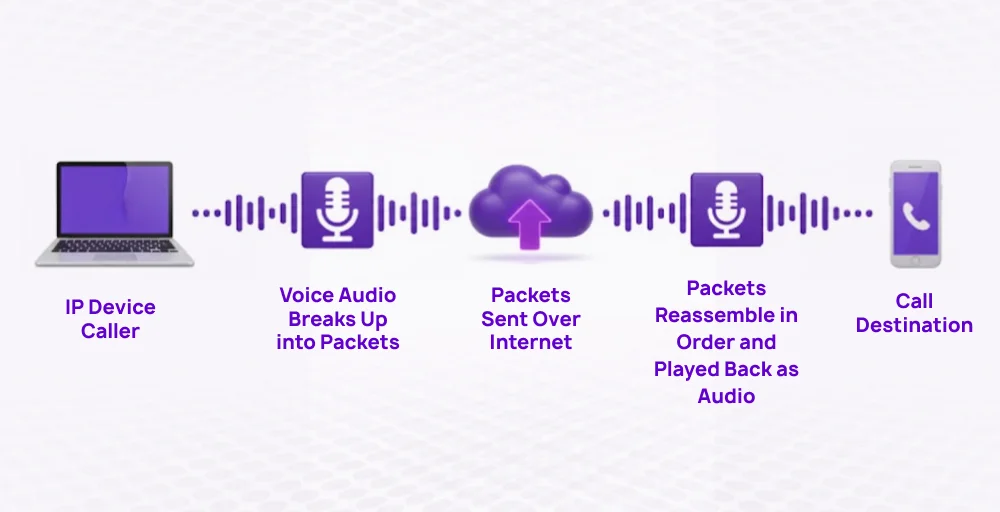
- Voice is converted into digital packets: The caller’s IP device (like a laptop or smartphone) captures analog voice audio through a microphone. An Analog-to-Digital Converter (ADC) samples and compresses this voice into digital packets using an audio codec (e.g., G.711 or Opus).
- Packets are transmitted using RTP: Each packet is labeled with the callee’s IP address and sequence numbers for correct reassembly. These packets travel across the Internet using the Real-time Transport Protocol (RTP), which is designed to accommodate the time-sensitive nature of audio.
- Managed via SIP servers and SIP trunking: The Session Initiation Protocol (SIP) is used to set up, manage, and terminate the VoIP call. A SIP client sends a request to a SIP server (often a PBX) when a number is dialed. For calls to landlines, SIP Trunking links the VoIP network to the Public Switched Telephone Network (PSTN).
- Received on IP phones, softphones, or apps: The destination device collects and reassembles the packets using sequence numbers and buffers them for any delays (jitter). A Digital-to-Analog Converter (DAC) then converts the digital signal back into audible sound for the recipient.
POTS vs PSTN vs VoIP: Key differences between them
POTS and PSTN are often used interchangeably; however, PSTN refers to the broader network, while POTS is the basic service that operates on it. VoIP is a separate, more modern technology that transmits voice calls over the internet.
However, the main differences between them are the technology they use, whether they rely on dedicated circuits or the internet, and the features each one offers.
| Aspects | POTS | PSTN | VoIP |
| Definition | The basic analog phone service runs using PSTN technology. | The global circuit-switched telecommunications networks that carry phone calls. | A technology that transmits voice calls as digital data packets over the internet. |
| Technology used | Analog, Circuit-Switched | Analog+Digital | Digital, packet-switched |
| Medium | Dedicated copper wires. | Mix of copper wires, fiber optics, and digital switches. | The internet can be delivered via broadband, Wi-Fi, or a cellular connection. |
| Hardware needs | PSTN-connected landlines | Landline and VoIP phones | Desktop, Laptop, VoIP phones, smartphones, tablets |
| Signal conversion | Voice is converted to a continuous analog electrical signal. | Varies, but modern PSTN converts signals to digital for long-distance. | Voice is converted to digital data packets and reassembled at the destination. |
| Mobility | Fixed location-based | Limited mobility for traditional landlines. | Accessible from anywhere as long as there is an internet connection. |
| Reliability | Very high | Consistent | 99.999% uptime, but it will not function if the internet connection is lost. |
| Key features | Call forwarding, hold, and voicemail. | Caller ID, voicemail, call hold, etc. | Auto attendants (IVR), call recording, and third-party integrations. |
Costs of PSTN vs VoIP
When comparing costs, VoIP phone systems are generally more cost-effective than traditional PSTN/POTS systems, especially for businesses. Traditional lines incur high charges for setup, maintenance of on-site PBX hardware, and long-distance calls. VoIP leverages existing internet infrastructure, significantly reducing setup costs.
Furthermore, hosted phone systems often bundle features like auto-attendants and conference calling into a low monthly per-user fee, eliminating the need for expensive dedicated equipment and offering significant savings on long-distance and international calling rates.
Call quality of POTS vs VoIP
VoIP typically provides equal or better call quality than traditional POTS or PSTN, especially with a stable, high-speed internet connection. While POTS lines offer a consistent, dedicated circuit, the quality is limited by analog technology. Modern VoIP utilizes high-definition (HD) voice codecs that deliver more transparent, more natural sound.
However, unlike POTS, VoIP call quality is dependent on bandwidth and network stability; issues such as network jitter, latency, or packet loss can occur if the internet connection is poor, leading to echo or choppy audio.
How to switch from POTS / PSTN to VoIP
There are many ways to switch from POTS and PSTN to VoIP, like:
Register with a VoIP service provider
One of the easiest ways to switch from a PSTN landline to VoIP is to just sign up for a VoIP service provider or hosted PBX phone system. Start by choosing a VoIP provider, then select a business phone number. Alternatively, you can also port your existing number or get a virtual phone number. Next, select a suitable plan and complete the purchase process; you are then free to use it.
Use SIP trunking to keep your current equipment
If you don’t want to change your existing hardware devices but still want to use VoIP, you can use SIP trunking for this purpose. It helps to establish a virtual connection between your on-site PBX system and a VoIP gateway.
It offers all the advanced VoIP features without requiring any expensive hardware. However, for the installation, setup, or maintenance of your existing equipment, you will need to take responsibility yourself. The SIP provider will not be responsible for this.
Choose PBX for a secure network with VoIP features
You can also switch to VoIP by using a PBX system, which offers all the hosted VoIP features with secure network connectivity. A Private Branch Exchange (PBX) is an internal business phone system that can connect all desk phones to a centralized and secure network.
The PBX can be hosted on-site by the business or in the cloud by a hosted PBX provider. The choice between an on-premise IP PBX and a hosted PBX depends on your company’s security, control, and feature requirements.
Choosing the right VoIP solutions for your business
As businesses continue to embrace digital transformation, VoIP (Voice over Internet Protocol) has emerged as the go-to cloud communications solution. It offers flexibility, scalability, and significant cost savings compared to traditional phone systems. However, not all VoIP phone services are created equal; choosing the right one can make all the difference in call quality, reliability, and user experience.
This is where a premier VoIP solution like KrispCall comes in. KrispCall is a unified cloud phone system designed for modern, agile businesses. It’s more than just a calling app; it’s a powerful communication hub designed to help you streamline operations, engage customers, and scale globally with ease.
Get started with KrispCall and discover how effortless, reliable, and affordable VoIP can be.